Jun ware in context, from looking at glaze to understanding the making · Central China
Yuzhou & Shenhou Guide: Jun Ware, Studios & Where to Stay
Plan Yuzhou and Shenhou for Jun ware: museum context, ceramic studios and realistic workshop choices, with hotel-base comparisons, purchase questions and firing or shipping explained.
A focused full day; 2 nights for a considered local introductionCeramics, material culture and a craft-focused Henan chapter without compulsory shopping
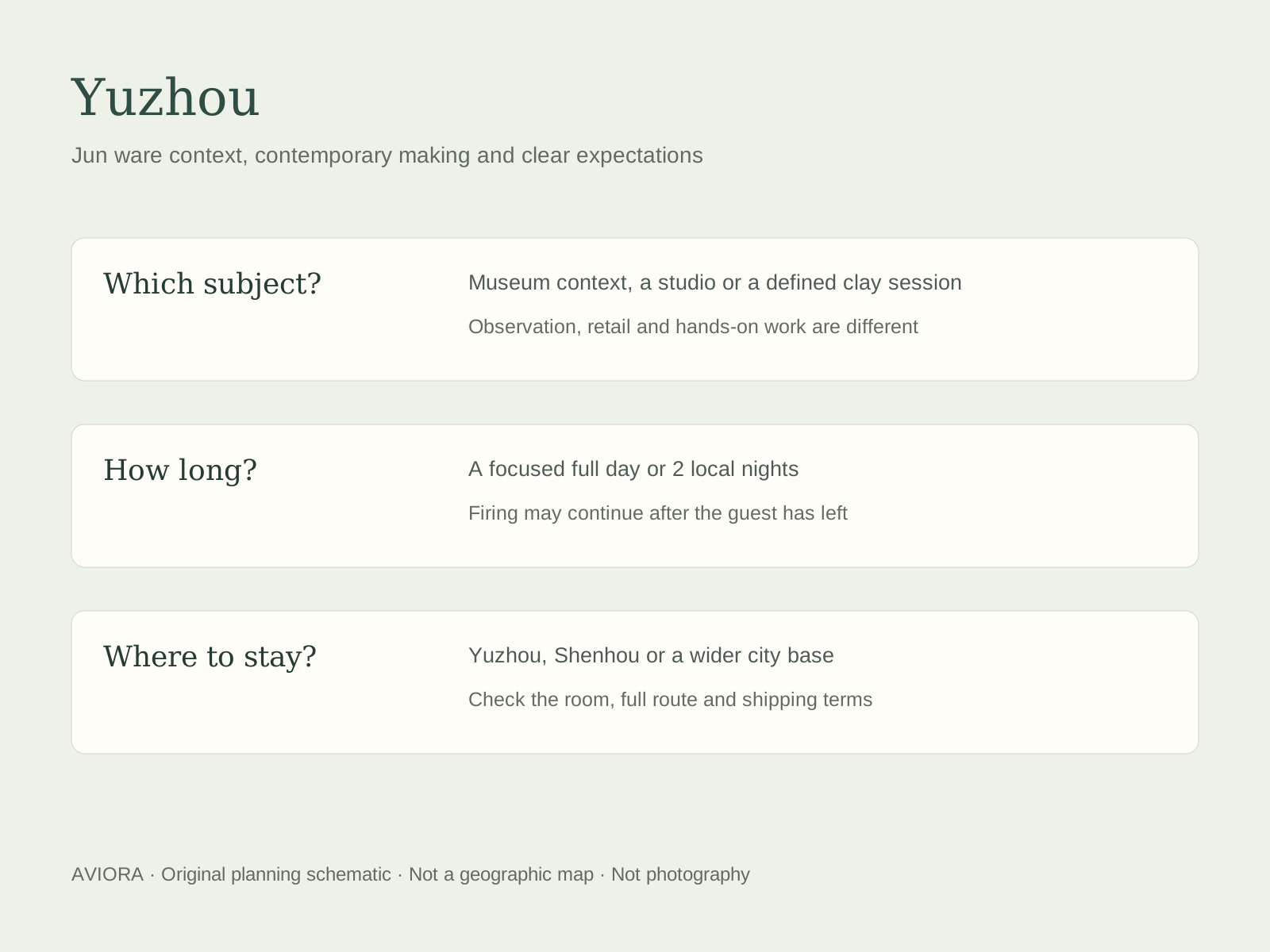
Yuzhou (禹州) is a city administered by Xuchang in Henan, associated with Jun ware (钧瓷) and the ceramic town of Shenhou (神垕). Choose it to understand the relationship between form, glaze, firing and the work of contemporary makers, with museum context for historical ceramics. Yuzhou’s urban center, the kiln-site museum interest and Shenhou are different stops. A focused day can combine a suitable museum or historical explanation with an arranged studio visit and time to look. A hands-on session needs its own provider, content and firing plan; it is not automatically included in a town walk or a showroom visit.
How many days do you need in Yuzhou?
A focused excursion can suit travelers keeping a comfortable Xuchang or Zhengzhou base when the full connection and actual appointments fit. One local night can divide the journey but needs useful arrival and departure hours. Two nights give one full day for museum context and a distinct studio interest. A longer stay needs a defined course or another genuine subject, not a succession of similar salesrooms. Waiting for a participant’s piece to be fired is not a reason to assume an extra night will be enough.
Compare stays by number of nights
Focused excursion / context and one studio
Retain Xuchang or Zhengzhou when the complete return journey leaves useful time for the selected museum and a real appointment. A thoughtful day does not require multiple retailers or a hands-on activity. Agree the content before choosing the transport.
1 local night / useful endpoints matter
Use a local night when it reduces pressure on the ceramic day or improves a wider Henan sequence. Compare the actual room and meals against another hotel move. A late arrival and early departure do not create a full workshop day.
2 local nights / one complete craft-focused day
Give museum context, a studio interest and an unhurried meal their own time. Stay longer only for defined instruction or a genuinely different subject. The drying and firing of a participant’s piece may extend beyond the visit and need later collection or shipment.
Plan a tailored Yuzhou visit
Share dates, gateway, available time, ceramics knowledge and whether you want to look, learn about production, make something or buy a contemporary piece. We can compare a focused excursion with a local stay and assess an actual provider. No matching published Yuzhou itinerary is listed here. A tailored plan should distinguish museum entry, studio content, any class and optional purchases, with firing and shipping treated as separate practical decisions.
A tailored proposal should name the museum, town route and willing studio provider, with guiding or interpretation, transfers, meals and room if staying. For a hands-on session, state the activity, teacher or instructor, language support, duration, materials, finishing, firing, collection or shipping and what happens if the piece fails. A private guide does not provide access to a working kiln, private home, historic excavation or named master. No purchase should be required to make a cultural visit worthwhile.
This is a destination planning guide, not a fixed departure or a confirmed package. We check the route, accommodation, transport and guide availability for your dates before setting out the services and price in writing.
Build the day around the actual museum hours and a willing studio’s working schedule, with travel and a seated meal between them. A kiln cycle or production stage is not a performance timetable. Leave time for questions and close looking rather than add multiple similar showrooms. A class needs its own setup and cleanup; do not put it tightly against an onward train or promise same-day firing.
01
Use museum context to understand historical Jun ware and the evidence behind labels
02
Look closely at contemporary form and glaze with a willing studio provider
03
Choose a defined making session or optional purchase for a clear reason
Suggested Yuzhou itinerary
What can you fit into your Yuzhou itinerary?
Before arrival / define the ceramic interest
Choose context, observation, making or purchase
Agree the actual museum and willing provider, full route and room if staying. Specify the content of any session and later processing. Keep shopping optional and separate from the cultural service.
Main visit / museum context
Learn what the historical labels can support
Use the available museum or kiln-history visit to look at objects and understand interpretation. Confirm current galleries and public access rather than promise every excavation or famous piece. Allow the full transfer and a proper meal.
Studio / a distinct contemporary interest
Ask questions about the work actually happening
Visit the agreed provider and observe the stage they can explain. Choose a making session only when separately arranged. Kiln firing, a named master and private working areas remain subject to real confirmation, not assumed inclusions.
Return or onward / finish the practical decisions
Leave with clear collection or shipping terms
Complete any optional purchase or participant-piece record, with readiness, packing, shipment and responsibility agreed. Return to the actual base or onward gateway with boarding counted. The tailored plan should name content, transport, meals and room without implying an unlisted product.
Choose dates around the actual museum and provider arrangements as well as weather. Spring and autumn can suit a mix of town walking and indoor explanation; summer requires heat and rain planning, while winter calls for reliable room and studio warmth. A working studio may change its availability independently of visitor season. No month guarantees firing, a kiln opening or a particular maker present. Holidays can alter services and the atmosphere of public streets.
What affects the cost of a Yuzhou trip?
Separate guiding, transport, museum admission, studio-host time and any class from optional purchases. For a session, identify materials, firing, finishing, storage, packing, shipping and possible destination charges. Agree cancellation and failed-piece terms. For a purchase, obtain the actual item description and price basis; no master title, future value, historic authenticity or food-use suitability should be inferred from an attractive glaze or premium price.
Getting there and getting around
How to get to Yuzhou and plan your stay
Arriving and connecting
Check dated services to the actual Yuzhou station or compare a complete road approach from Xuchang or Zhengzhou. Include the transfer to the room, museum or Shenhou appointment; the rail station and ceramic town are not the same destination. Count luggage, meals and boarding at the other end. For a studio visit, agree a realistic arrival window after the complete journey rather than promise a maker can wait indefinitely for a delayed train.
Getting around
Use a defined road plan between the city, chosen museum, Shenhou and named studio. In public streets, choose a manageable route with seats and toilets rather than assume every shop is an open workshop. Respect working areas, equipment and photography wishes. Confirm thresholds and the actual session space before describing it as accessible. A private vehicle serves permitted road endpoints and does not establish entry to historic kilns or private production rooms.
Walking and access
Museum visits include standing, gallery distances and possible changes of level. Shenhou streets and studio entrances can have uneven paving, thresholds, steps and vehicle activity. Check seats, toilets, ventilation and the actual working area before arranging a session. A showroom may be easier to enter than a production space; confirm both separately. Do not infer step-free access from a town walk or private vehicle.
What first-time visitors often underestimate
Begin with what you want from ceramics: to understand, observe, make or buy. Each leads to a different kind of visit. A well-explained museum and studio day can be complete without a purchase, and a short clay session can be enjoyable without producing a professional finished work. Good planning makes the actual content and limits clear before the guest arrives.
Where to stay in Yuzhou
Compare a named Yuzhou urban hotel for meals and conventional services with a specific Shenhou property chosen for its actual room and arranged visits. Retaining Xuchang or Zhengzhou can avoid another hotel move while adding a full return journey. Check noise, bathroom, heating or cooling, breakfast, dinner, luggage and pickup. A courtyard or pottery-themed room is not proof of historic fabric, a working kiln, host availability or a ceramics session outside the door.
Compare hotel areas
Yuzhou urban address / conventional services
Compare the actual room, dinner and road plan to the selected museum and Shenhou. The city base may offer practical services while adding a drive to the craft town. Check sleep, bathroom, climate control and pickup rather than use a city-center label alone.
Named Shenhou property / a deliberate town stay
Choose only when the actual room and confirmed visit sequence reward staying. Check street noise, heating or cooling, bathroom, dampness, luggage, meals and the final vehicle point. A pottery-themed property does not include a maker, kiln access or a class.
Retain Xuchang or Zhengzhou / avoid another move
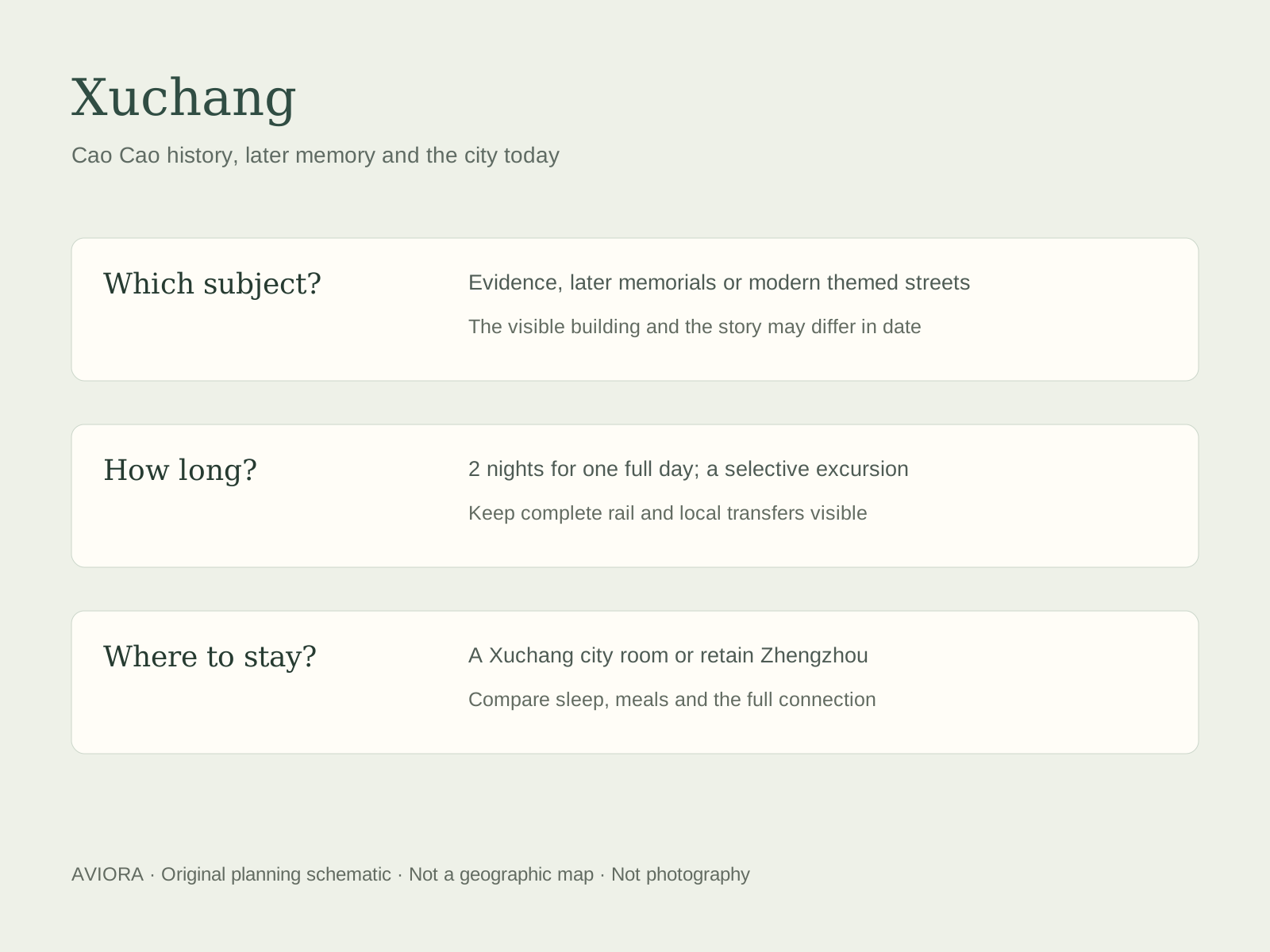
Compare both full transfers and the actual museum and provider schedule with the value of a familiar hotel. Xuchang’s city history and Shenhou’s ceramic interests are different days or carefully selected components, not one automatic compact circuit.
Should I choose a Jun ware museum, a studio visit or a pottery class?
Choose museum context to understand historical material and how it is interpreted. Choose an arranged studio visit to see what a willing contemporary maker actually does and ask questions about form, glaze and firing. Choose a hands-on session when you want to work with clay and the provider can define the instruction, materials and later processing. These can complement one another, but a retail display does not establish production access, and a short class cannot guarantee a fired Jun-style result to take home that day.
Jun ware is more than a color label
Look at the relationship between shape, surface, glaze thickness and the way color develops in firing. The result depends on materials and kiln conditions; a promotional purple or blue pattern is not a guaranteed outcome for a guest’s piece. Historical attribution, contemporary production and the language of a sales label should be kept distinct.
A studio visit is not a guaranteed kiln opening
A working maker has a production cycle, workspace limits and practical reasons to restrict access. Ask which stage can actually be explained or observed. A showroom can support close looking, but should not be sold as a behind-the-scenes production visit. Firing, cooling and unloading are not scheduled around every guest appointment.
Making a form and receiving a finished ceramic are separate stages
Define whether the activity is hand-building, throwing, decorating or another task, and what help is provided. Clay may need drying, trimming, glazing and firing after the guest leaves. Confirm who completes each stage, whether the chosen form is suitable and what happens if it cracks or the result differs from expectations. Do not guarantee a finished Jun piece from a brief session.
Purchase the actual piece, not an implied pedigree
Ask who made the object, where it was produced, what the invoice describes and whether marks or certificates are maker claims or independently supported evidence. Distinguish a contemporary work from an object sold as antique; do not infer age, rarity or investment value from a seal or price. Inspect the surface and condition. Decorative ware should not be assumed suitable for food or drink.
Packing and shipping are part of the decision
For a purchased or participant-made piece, agree when it will be ready, the packing, carrier, destination, tracking and responsibility for damage or loss. Check applicable transport and destination requirements before dispatch, with charges and any return terms clear. A studio receipt or a promise of worldwide delivery does not by itself resolve every shipment or authenticity question.
Culture and historical context
Look at the object, then ask how it was made
The attraction of Jun ware can begin with a surface: a transition of color, a glaze that gathers differently around an edge, or the relationship between the body and a vessel’s shape. Slow looking is useful before discussing a label or a price. Ask which effects arise from the materials and firing and which decisions belong to the maker, while accepting that the result is not fully described by one romantic phrase about kiln change.
A museum and a contemporary studio offer different evidence. Historical ceramics need careful attribution and context; a living maker can explain a particular present-day practice. Neither should be used to validate every object in a shop. Distinguish the claimed maker, the production process, a repeated design and a one-off result. A good visit can build judgment without turning into a test of connoisseurship or an obligation to buy.
Food and social life
A real lunch between looking and making
Leave the studio visit for a seated meal rather than depend on an unspecified tasting in a workshop. Ask the chosen Yuzhou or Shenhou kitchen what it prepares well and build a manageable meal around a staple, vegetables and a preferred protein. Wheat-based dishes can be a familiar starting point in Henan, but the kitchen’s actual broth, ingredients and preparation matter more than a generic regional menu.
Confirm breakfast and dinner if staying in a smaller town property, and state dietary needs in concrete terms including stocks, meat, wheat, soy and shared preparation as relevant. A ceramics venue serving tea does not automatically provide lunch or a hosted family meal. A comfortable pause can give the guest time to reflect on the morning before another conversation or making session, without adding a staged banquet.
Yuzhou travel FAQ
Questions about visiting Yuzhou
Is Yuzhou worth visiting for ceramics?+
Choose it for Jun ware context and a considered Shenhou studio interest. A focused day can connect form, glaze and making without compulsory shopping. The value depends on the actual museum and willing provider, rather than a promise that every shop is a working kiln.
Where is Shenhou and is it in central Xuchang?+
Shenhou (神垕) is a ceramic town in Yuzhou, within the wider Xuchang administrative area of Henan. It is not central Xuchang or Yuzhou railway station. Count the full transfer to the actual town venue or studio.
What is Jun ware?+
Jun ware refers to a ceramic tradition associated with distinctive glazes and firing effects, strongly linked with the Yuzhou area. Historical objects and contemporary production need separate interpretation. A glaze color or maker’s mark alone does not establish age, rarity or value.
Should I visit a museum or a Jun ware studio?+
A museum can provide historical context; an arranged studio visit can explain contemporary practice through a willing maker’s actual work. They can complement one another. A showroom, production visit and hands-on session should be described separately.
Can I make my own Jun ware in a short class?+
A defined clay-working activity may be possible with a willing provider, but a brief session does not guarantee a finished Jun piece. Confirm instruction, materials, later drying, glazing, firing, failed-piece terms and collection or shipping before booking.
Can I take my pottery home on the same day?+
Do not assume so. The piece may need further drying, finishing, glazing and firing after the session. Ask exactly what is made, who completes it, when it can be ready and how collection or shipment works. An extra local night may still be insufficient.
Will I see a working kiln or meet a master?+
Only when a named willing provider and the actual production stage have been confirmed. A town walk, studio listing or retail visit does not establish kiln access, a firing or a particular person’s attendance. No title or special relationship is assumed.
Do I need to buy ceramics during a Shenhou visit?+
A cultural visit should have defined content and host terms without requiring a purchase. If buying, inspect the actual item and agree its description, price, packing, shipping and condition terms. Do not infer antique authenticity, investment value or food-use safety from its appearance.
Should I stay in Yuzhou or visit from Xuchang?+
Compare the complete return journey with the actual room, meals and provider schedule. A focused excursion can be enough. Two local nights give one full day when a local stay genuinely improves the trip; Shenhou and Yuzhou urban hotels are different addresses.
Is there a published Yuzhou or Shenhou tour here?+
No matching itinerary is listed on this page. Share dates, gateway, available time and whether you want museum context, a studio, making or an optional purchase for a tailored assessment. The outline is not a new package or a guaranteed class.
Share your dates, interests, arrival and departure cities, and any plans already booked. We’ll recommend an itinerary at a pace that suits you, with the arrangements and price explained before you book.