A northern Henan base for Xunxian heritage, with the places kept distinct · Central China
Hebi Travel Guide: Xunxian, Dapi Mountain & Where to Stay
Plan Hebi for a selected Xunxian and Dapi Mountain heritage day, or a defined Qihe riverside interest. Compare hotel bases, steps, historic fabric and actual rail transfers.
2 nights for a focused full heritage day; 1 for a useful connectionBuddhist sculpture, historic-town interests and a considered northern Henan stop
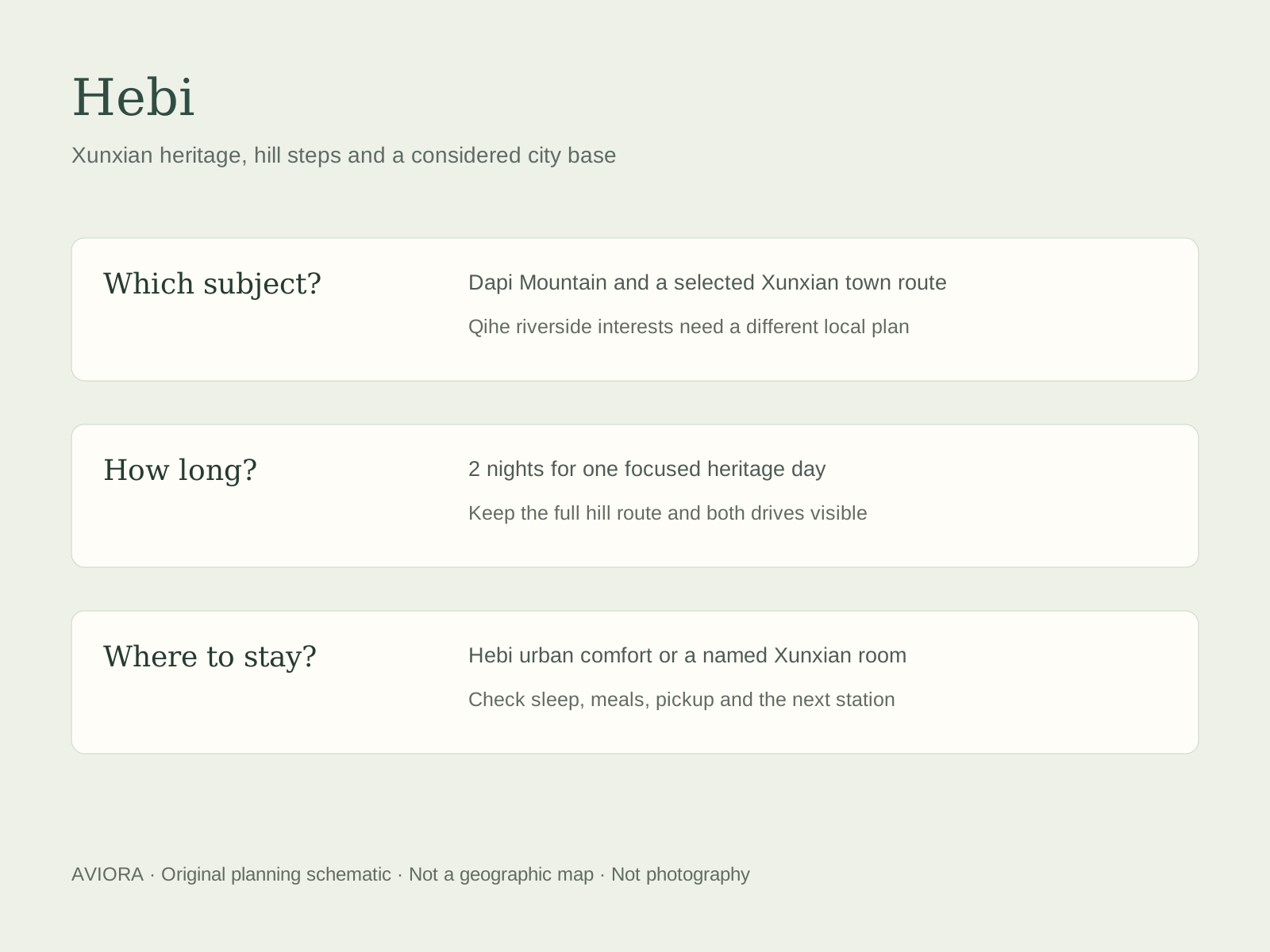
Hebi (鹤壁) is a city in northern Henan. For a cultural stay, a strong reason to stop is a selected visit to Xunxian (浚县), a separate county town within the wider Hebi area, combining its historic-town setting with Dapi Mountain (大伾山) and the large stone Buddha. Choose the actual public route and allow time for looking, interpretation and steps. A Qihe River (淇河) interest belongs to a different local plan and should name the particular public riverside section. Two nights give one full heritage day when arrival, hotel and access fit. Hebi’s urban center, railway stations and Xunxian are not interchangeable bases.
How many days do you need in Hebi?
Two nights provide one full day for a selected Xunxian and Dapi Mountain interest, with the complete drives and a proper meal. One night can support a real connection or narrower visit when arrival and departure create useful time. Three nights need a distinct second subject or a slower stay at a property that suits you. Do not add a city night automatically to every northern Henan journey, or assume an evening in Hebi includes a full Xunxian visit.
Compare stays by number of nights
1 night / a useful connection or narrow introduction
Choose only when the actual arrival and departure support useful time. A late check-in and early train can provide no more than dinner and sleep. Do not turn a rail connection into an invented full cultural day.
2 nights / one focused heritage day
Choose Dapi Mountain and a selected Xunxian town route, with the complete drives, steps, interpretation, meal and breaks. The day can be complete without adding every nearby hill or a distant river section.
3 nights / a genuinely different second day
Use extra time for another substantive interest or a slower stay when the actual room supports it. A named Qihe outing has a separate route and current access. More nights should deepen the plan rather than repeat town walks or hide long transfers.
Plan a tailored Hebi visit
Share dates, actual gateway, available nights, walking ability and whether Buddhist sculpture, historic streets or a gentler riverside interest matters most. We can compare a focused heritage day from Hebi with a named Xunxian stay. No matching published Hebi itinerary is listed here. A tailored proposal should identify the selected areas, steps, room and full connections, with an actual alternative if a chosen interior or route is unavailable.
A tailored Hebi proposal should name the hotel, selected Xunxian streets and Dapi Mountain visitor route, guiding, admissions, full transfers and meals. A Qihe interest should state the actual public section and activity. Interpretation should distinguish surviving fabric, repairs, later commemorative layers and modern visitor construction. Private homes, religious spaces, artisan sessions, boats and special photography require their own willing providers or permissions; none is implied by a public town walk.
This is a destination planning guide, not a fixed departure or a confirmed package. We check the route, accommodation, transport and guide availability for your dates before setting out the services and price in writing.
Give Dapi Mountain’s selected route time for the approach, steps and explanation rather than count only time beside the Buddha. Combine a manageable town walk and a seated meal if hours and stamina allow. Qihe is another transfer and location decision, not an assumed continuation from the old town. Keep the complete station journey and boarding outside the sightseeing window.
01
Look closely at Dapi Mountain’s Buddha with the viewing route and steps understood
02
Read selected Xunxian streets and architecture through distinct historical layers
03
Choose a particular public riverside interest or city base for a clear reason
Suggested Hebi itinerary
What can you fit into your Hebi itinerary?
Arrival / choose the actual room
Reach Hebi or Xunxian with the visit understood
Complete the transfer from the named station and settle luggage. Confirm dinner, the next day’s public route and walking needs. An optional short walk depends on time and conditions rather than an assumed late opening.
Full day / the principal heritage interest
Give Dapi Mountain time and context
Follow the selected operating route at the guest’s pace, with ascent and descent assessed. Look closely at the Buddha and available architecture, distinguishing the historical layers. Leave a proper meal and breaks.
Town or separate interest / choose deliberately
Read a manageable part of Xunxian
Explore selected public streets or a compatible open interior when hours and energy allow. A Qihe section or craft visit requires its own route or willing provider; it is an alternative to assess, not an automatic inclusion.
Departure / onward northern Henan
Protect the complete connection
Leave for the actual station or next hotel with the full road journey and boarding counted. The tailored proposal should name visits, guiding, steps, room, meals and alternatives without implying a newly published product.
Spring and autumn can suit hill, town and riverside walking, with weather varying by date. Summer requires shade, water and rest on exposed approaches; rain can affect paving and steps. Winter calls for warm clothing and footing checks. Religious interiors, public routes and events have their own opening decisions. A temple-fair interest needs the actual current program and date, not a general seasonal label. Holidays and event days can change the pace considerably.
What affects the cost of a Hebi trip?
Compare the exact room, vehicle hours, guide expertise, selected admissions, meals and any included internal transport. Identify optional activities or events only when genuinely arranged. A historic-town label does not mean every temple, performance or craft session is included. Agree change terms for unavailable routes; a premium should buy useful time, comfort and interpretation rather than promised empty streets or special religious access.
Getting there and getting around
How to get to Hebi and plan your stay
Arriving and connecting
Check dated services to Hebi or Hebi East and use the station on the actual ticket for the transfer. Continue to the booked Hebi urban or Xunxian room with luggage and meals counted. A late rail arrival should not be described as a full town visit. For departure, include the complete county-town road journey and boarding before choosing a train that depends on a fast hill descent.
Getting around
Use a defined road plan between the hotel, selected Xunxian entrance and any separate river section. Inside, follow the permitted town and hill routes, with current interior and photography rules understood. Ask about seats, toilets, steps and a shorter option. Public lanes do not include private courtyards, fields or religious spaces, and a driver cannot remove the internal climb.
Walking and access
Assess Dapi Mountain as a stepped hill-and-temple visit, not a level roadside sculpture stop. Ask for the actual open approach, ascent and descent, handrails, rest points and a shorter option. Town paving, thresholds and crossings have their own demands. A riverside route needs its own surface, shade and exit assessment. Heat, rain and winter footing can change suitability even on a short day.
What first-time visitors often underestimate
Start with whether the main interest is a Buddhist sculpture and historic-town day or a more gentle city-and-river stay. They lead to different routes and bases. A good guide can explain one sculpture and a few streets deeply without claiming every building is ancient or every craft activity privately arranged. A manageable day with useful interpretation is a complete visit.
Where to stay in Hebi
Compare a named Hebi urban property, often in the newer Qibin-area planning context, with an actual Xunxian county-town room. Hebi can suit conventional services and the wider rail sequence; Xunxian can reduce part of the heritage-day approach and add a town evening. Use the exact address, room and road plan. Check noise, bathroom, heating or cooling, breakfast, dinner, luggage and pickup. A historic-style facade does not establish original fabric or a high level of service.
Compare hotel areas
Hebi urban / named Qibin-area address
Compare the actual room with your railway gateway, meals and the full Xunxian road journey. Check sleep, bathroom, climate control and pickup. A broad district name does not establish a short transfer to both the station and heritage area.
Xunxian county town / a purposeful heritage stay
Choose the booked room for its actual comfort and route to the selected public visits. Ask about dinner, breakfast, noise, steps, luggage and vehicle access. An atmospheric exterior does not establish a preserved historic house or private host.
Station-oriented room / a specific transit need
Use the actual Hebi or Hebi East station rather than an interchangeable rail label. Check meals and full sightseeing transfers before trading a useful city or town evening for one departure. A station hotel serves a practical need, not every cultural route.
Should I stay in Hebi city or Xunxian for Dapi Mountain?
Choose the actual room and complete journey rather than the administrative name. A suitable Hebi city hotel can provide preferred comfort but adds the road trip to Xunxian and back. A Xunxian room can offer an evening and a more direct start when its meals, sleep and access meet your needs. Dapi Mountain’s steps and current visitor route remain separate questions; a closer hotel does not remove the climb or establish access to every hall.
Xunxian is part of wider Hebi, not the same urban location
Use the actual county-town address and visitor entrance when planning. A Hebi hotel or station does not put you beside Dapi Mountain, and a Xunxian overnight is not automatically a Hebi urban stay. Compare both directions of road travel and the next gateway before deciding where to sleep.
The large Buddha deserves careful attribution
Dapi Mountain’s large stone Buddha is a distinct local Buddhist-art interest. A strong explanation separates the sculpture, the structure protecting it, later repairs and the interpretation of its date. Avoid unsupported claims that it is China’s oldest or largest. Confirm the actual viewing route, proximity and photography rules rather than promise every angle.
Historic-town appearance is not one continuous period
Read surviving streets, religious or civic architecture, repairs and modern visitor construction separately. A reconstructed gate or commercial lane can have a role in today’s town without being original ancient fabric. Choose a few places for meaningful explanation rather than describe every facade as untouched heritage.
Qihe needs a particular place and activity
The river name can refer to a broad landscape, different public sections and distinct local attractions. Specify the route, public access, walking and pickup. A riverside photograph does not establish swimming, boating, a continuous trail or protected-land access. Compare this gentler interest with the heritage day instead of treating it as the same circuit.
Temple fairs and clay-toy interests require real arrangements
Xunxian’s festival and clay-toy associations can be meaningful when the date, location and willing host fit. Do not assume a performance, workshop or market operates daily. A public fair and a private lesson have different content and conditions; a town visit does not include entry to a maker’s home or a guaranteed cultural ceremony.
Culture and historical context
Look at a sculpture, a building and a street as different evidence
A visit to Dapi Mountain can begin with the large Buddha, then ask how the sculpture is seen and protected today. The carving, its surrounding architecture, later repairs and the visitor route belong to different parts of the story. A careful guide should identify those layers and the basis for any historical attribution instead of relying on an unsupported superlative.
The same approach helps in Xunxian’s town setting. Surviving buildings, repaired structures and contemporary commercial streets can all contribute to the visit without being the same kind of evidence. For a craft or festival interest, explain what belongs to the current date and community rather than promise a timeless performance. Public observation can be meaningful without access to a private home or a staged ceremony.
Food and social life
Make a proper town meal part of the heritage day
Leave time for a seated lunch after the selected hill route or between town visits. Ask the chosen Xunxian or Hebi kitchen what it prepares well and build a manageable meal around a staple, vegetables and a preferred protein. Wheat-based dishes can be an approachable regional starting point, with the actual noodles, bread, broth or filling explained rather than a claim that every dish is unique to the town.
Confirm ingredients and preparation for dietary needs, including meat stocks, wheat, soy and shared utensils as relevant. Keep unfamiliar snacks optional and agree breakfast if the next day begins with a station transfer. A restaurant in an old street does not establish ancient recipes, family hosting or a cooking session. Good service and time to discuss the morning can provide more value than an exaggerated banquet story.
Hebi travel FAQ
Questions about visiting Hebi
Is Hebi worth visiting?+
Choose Hebi for a selected Xunxian and Dapi Mountain heritage day, a particular Qihe interest or a useful northern Henan base. The value depends on the actual route, interpretation and room, rather than the number of attractions carrying the city’s name.
Is Xunxian in Hebi city center?+
No. Xunxian is a separate county town within the wider Hebi administrative area. The urban hotel, rail station and Dapi Mountain entrance need distinct transfer planning. A Hebi station arrival is not an arrival in the old town.
What is there to see at Dapi Mountain?+
The large stone Buddha and selected public temple or hill interests can support a focused Buddhist-art visit. Confirm the actual route, open areas, steps and photography rules. Avoid unsupported oldest or largest claims and distinguish the sculpture from later protective buildings.
Is Dapi Mountain suitable for guests who avoid stairs?+
Assess the actual ascent, descent, handrails, rest points and shorter route before booking. It should not be described as a level roadside stop. A private vehicle to an entrance does not remove internal steps or make every viewing point accessible.
Should I stay in Hebi or Xunxian?+
Compare the exact city room and both heritage-day drives with a Xunxian property’s comfort, meals and local access. A county-town evening can be rewarding, but a larger urban hotel may suit some guests better. Use the actual next station in the comparison.
How many nights should I spend in Hebi?+
Two nights give one full day for a focused Xunxian heritage plan. One can serve a real connection or narrow visit when hours fit. Three need a distinct second interest or slower stay; more nights do not imply more confirmed cultural activities.
Are all the buildings in Xunxian ancient?+
No blanket claim is appropriate. Distinguish surviving historic fabric, repairs, reconstruction and modern commercial or visitor buildings. A historic-town atmosphere can be enjoyable without presenting every facade as original. Choose specific sites for explanation.
Can I take a Qihe River boat trip?+
Do not infer a boat service from the river name or a photograph. Specify the actual public section and confirm whether the proposed activity operates, with boarding and terms understood. A riverside walk is a different experience from a boat trip or swimming.
Can I visit a Xunxian clay-toy maker?+
Only when a willing provider, location, date and content have been agreed. A town or festival association does not establish daily workshop access or a private lesson. Keep a public market visit separate from a hosted conversation or hands-on activity.
Is there a published Hebi tour here?+
No matching product is listed on this page. Share dates, actual gateways, nights, walking needs and heritage or riverside priorities for a tailored assessment. The outline is not a new package or a promise of private cultural access.
Share your dates, interests, arrival and departure cities, and any plans already booked. We’ll recommend an itinerary at a pace that suits you, with the arrangements and price explained before you book.