Shang archaeology and early writing, with the evidence made readable · Central China
Anyang Travel Guide: Yinxu, Oracle Bones & Where to Stay
Plan Anyang for Yinxu, oracle bones and Shang history. Choose museum and archaeological-site visits deliberately, compare hotel bases and leave room for a deeper Henan route.
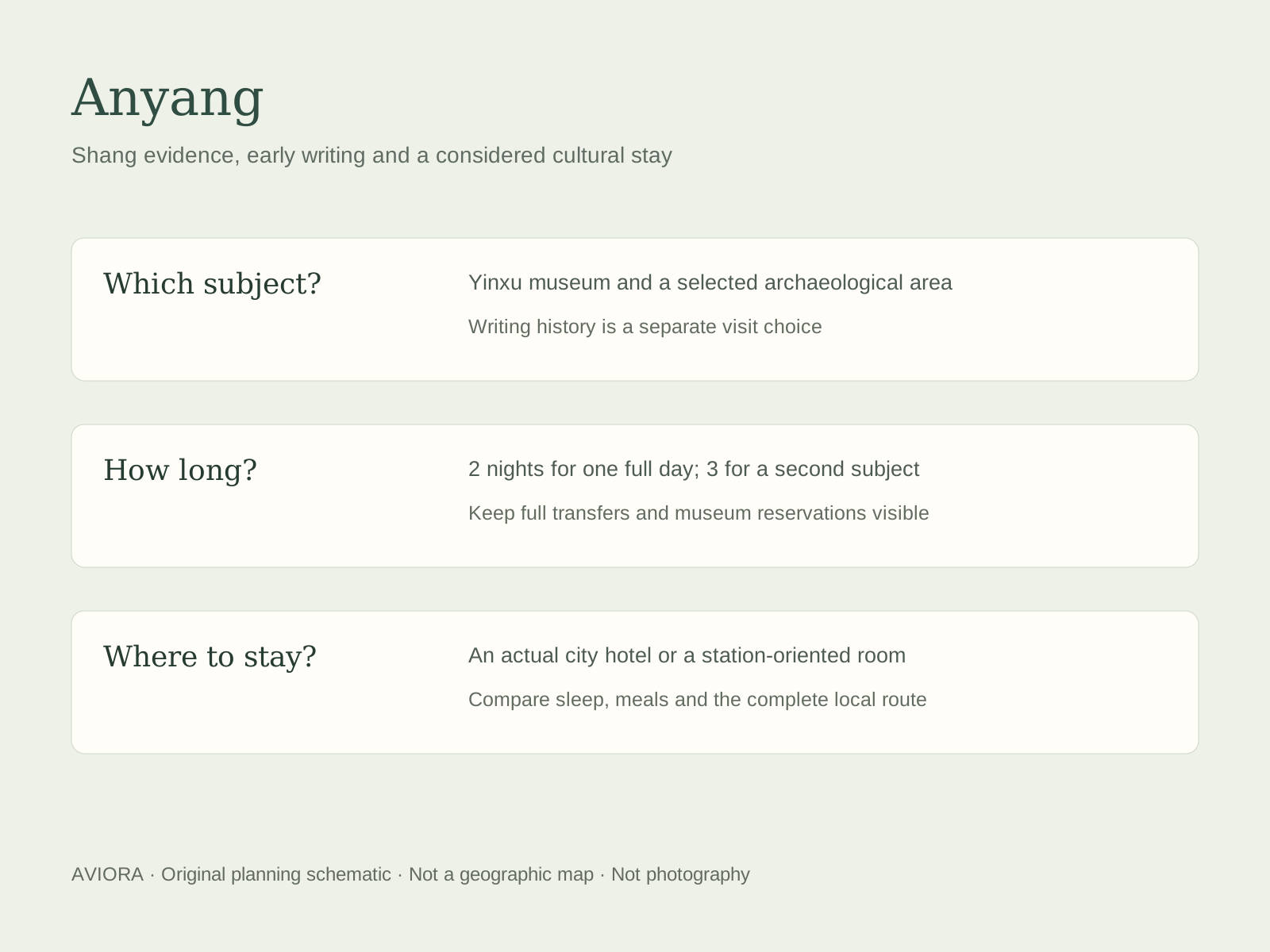
2 nights for a focused Shang day; 3 for a distinct second subjectArchaeology, early Chinese writing and a quieter cultural chapter in Henan
Anyang (安阳) is a city in northern Henan, best known for Yinxu (殷墟), the archaeological remains of a late Shang royal center, and the oracle-bone inscriptions that illuminate its world. Choose Anyang for the relationship between excavated places, objects and early writing. The modern Yinxu Museum and the archaeological visitor areas are different parts of that story; neither should be treated as an interchangeable stop called the ruins. Two nights give one full day for a selected museum-and-site plan. Three nights can add a separate writing-history or later architectural interest without turning the visit into a rush between collections.
How many days do you need in Anyang?
Two nights provide one full day, a useful first stay for the principal Shang interest when arrival and departure work. Three nights give two full days for a separate writing-history visit, city architecture or a carefully chosen excursion. One night can support a narrower plan with favorable train times, but cannot promise every Yinxu area and another museum. A Zhengzhou excursion needs both full station and local transfers counted; fast rail alone does not make the day relaxed.
Compare stays by number of nights
1 night / a tightly selected introduction
Choose only when train times leave useful museum or site hours. Decide the main subject first and avoid adding another museum simply because it appears nearby. Include the complete arrival and departure, not only the rail sector.
2 nights / one full Shang-focused day
Connect the museum with a selected archaeological area and a proper meal. Good interpretation can trace a question through objects, inscriptions and place without requiring every area. Leave an evening for a comfortable dinner rather than add a distant excursion.
3 nights / a genuinely different second day
Add writing history, later city architecture or a selected Tangyin interest on its own terms. Match the second day to current openings and full transfers. More time should deepen the story, not repeat similar displays or consume the day moving hotels.
Plan a tailored Anyang visit
Share dates, gateway, available nights and whether archaeology, oracle-bone writing, bronze art or later architecture matters most. We can compare a focused Shang day with a two-full-day stay and place Anyang within a coherent Henan journey. No matching published Anyang itinerary is listed here. A tailored plan should name the museum and site areas, walking and display priorities, with an alternative if a reservation or chosen gallery is unavailable.
A tailored Anyang proposal should identify the actual museum, selected archaeological visitor area, interpretation, full transfers, admissions, meals and hotel. Guiding should connect the evidence to the questions that interest you, distinguishing excavated objects, replicas, later displays and reconstructed elements. Research meetings, stores, active excavations, handling objects and private gallery access require separate authorization and are not implied. Confirm language support and reservation procedures before relying on a ticket or an English museum name.
This is a destination planning guide, not a fixed departure or a confirmed package. We check the route, accommodation, transport and guide availability for your dates before setting out the services and price in writing.
Give the principal museum time for explanation and looking, with a seated meal before a selected site visit. Decide the order around current reservations, weather and stamina. Museum standing and outdoor walking can be tiring even without a strenuous climb. A writing-history museum is a distinct subject, not an automatic extra after every Yinxu area. Keep station transfers and boarding outside the sightseeing allowance.
01
Connect late Shang objects and inscriptions with a selected archaeological setting
02
Follow an oracle-bone question through the evidence rather than a list of famous finds
03
Choose writing history or later city architecture as a distinct second interest
Suggested Anyang itinerary
What can you fit into your Anyang itinerary?
Arrival / settle the base
Reach the actual hotel and frame the questions
Complete the station transfer, settle luggage and enjoy dinner. Confirm the next day’s museum reservation, selected archaeological area and walking needs. A short city walk is optional when time and conditions fit.
Full day / the Shang focus
Connect objects and inscriptions with place
Use the available museum session to understand the main evidence, then visit a selected archaeological area with the full transfer and a proper meal allowed. Adjust the order for booking, weather and energy. Do not assume every site component must be completed.
Additional full day / a different lens
Choose writing history, city architecture or an excursion
With a third night, give a separate writing-history visit or selected later architecture useful time. A Tangyin subject needs its own full plan; Linzhou is another excursion decision. Choose one coherent direction rather than promise all alternatives.
Departure / onward Henan or gateway
Protect the complete connection
Continue to the actual station or next hotel with luggage and boarding counted. The tailored proposal should identify museum and site areas, interpretation, meals, room and alternatives for unavailable bookings, without implying a new published product.
Spring and autumn can suit a mix of galleries and archaeological paths, with weather varying by date. Summer calls for heat and rain planning on the outdoor sections; winter can make exposed walking cold and footing less comfortable. Indoor museums offer a different balance but still need actual reservations and opening checks. Public holidays can alter availability and queues. Choose the day sequence around the available museum slot, weather and the guest’s energy rather than a fixed best-month promise.
What affects the cost of a Anyang trip?
Compare the named hotel, guide expertise, vehicle hours, museum and site admissions, and any internal transport. Clarify which reservations and identification requirements apply, and whether special exhibitions cost extra. A city museum, Yinxu Museum and an archaeological area should each be named instead of bundled under a vague ruins ticket. A premium should buy demonstrable time, comfort and interpretation, not promised curator meetings or a famous bronze on display.
Getting there and getting around
How to get to Anyang and plan your stay
Arriving and connecting
Compare dated rail services using Anyang East (安阳东) or Anyang (安阳) as the actual arrival station; they are different gateways. Include the transfer to the hotel or named museum, luggage and reservations before promising useful sightseeing. For Zhengzhou or Beijing connections, the departure station and approach also matter. A late arrival is best planned around dinner and sleep rather than an assumed museum opening.
Getting around
Use a defined local transfer plan between the hotel, museum and selected archaeological area. Confirm current entrance and pickup points before relying on a broad Yinxu pin. Internal routes have their own walking and access rules, and protected excavations are not public paths. For city architecture, check opening and remaining steps rather than infer entry from a view of a pagoda. Tangyin and Linzhou need separate full route assessments.
Walking and access
Museum visits involve standing, gallery distances and possible changes of level; archaeological visitor areas add outdoor paths, surfaces and varying steps. Ask about the actual entrance-to-exit route, seats, lifts and accessible alternatives rather than call an ancient site flat. Summer heat, rain and winter footing can alter comfort. A private car can connect entrances but does not remove internal walking or permit entry to protected excavation areas.
What first-time visitors often underestimate
Begin with one question: what can objects, places and inscriptions tell us about the late Shang world? A good guide can make that question readable without expecting prior knowledge of Chinese dynasties. Choose a focused museum-and-site plan, look closely and leave room to ask questions. There is no need to see every display, read ancient script or visit an active excavation for the day to have depth.
Where to stay in Anyang
Compare a named central or Wenfeng-area hotel for meals and selected city walks with a Beiguan-area address chosen for the actual route to Yinxu. An Anyang East station-oriented room serves a transport purpose and can add travel to the main visits. District names cover broad areas, so compare addresses rather than promise a short journey from the label. Check room noise, bathroom, heating or cooling, breakfast, dinner access and vehicle pickup. A local boutique or heritage-style name does not establish historic fabric or superior service.
Compare hotel areas
Central / Wenfeng-area address
Useful for a chosen city walk and meals when the actual hotel fits. Compare noise, vehicle access and the complete route to Yinxu and the station. Old-city atmosphere does not automatically mean a quiet bedroom or step-free pickup.
Beiguan-area property / choose by the Yinxu route
Consider a suitable room for its actual relationship to the museum and selected archaeological areas. The district is not a single attraction entrance, and a ruins-near listing may not suit the chosen visit. Confirm dinner and breakfast as well as the road journey.
Anyang East station-oriented room / a real transit need
Choose this when a specific departure or arrival makes it worthwhile. Include the road travel to the cultural visits and check evening meals. A station-area hotel is not automatically an efficient base for two full days of museum and site visits.
Should I visit Yinxu Museum, the ruins or both?
For a first Shang-focused visit, compare a substantive museum session with one selected archaeological visitor area. The museum helps make objects and excavation evidence intelligible; a site visit adds the spatial setting and material remains. Choose the actual areas, transfers and walking before booking. Do not assume the museum, palace-and-temple area, royal cemetery and every excavated tomb share one entrance or ticket, or that all are open. A well-interpreted selection can be more rewarding than completing every component.
The museum and archaeological areas do different work
Use the museum to understand excavated objects and the interpretation of evidence. Use a selected site area to understand scale, location and material remains. The palace-and-temple area, royal cemetery and other components have separate spatial and visitor questions. Confirm what is open and how to move between the chosen parts rather than assume one walking loop.
Oracle bones are evidence, not decorative ancient characters
The inscriptions relate to divination and the concerns of the late Shang royal world. A useful explanation can show how the material, marks and written record fit together, while distinguishing established readings from uncertainty. Do not present a rubbing, replica or modern souvenir as an excavated original, or assume a short visit teaches visitors to read ancient script.
Famous objects do not all remain where they were excavated
Important finds from Anyang can be held by different collections, and loans or exhibitions change. Ask what the current display actually includes instead of promising a particular famous bronze from an old photograph. The visit can remain valuable through the questions and available evidence; replicas should be identified as such.
Burial interpretation needs context and a choice
Some Shang archaeological interpretation includes human and animal sacrifice, burial practices and excavated remains. Ask what the selected visitor area or gallery presents and choose the emphasis for children or sensitive guests. Explain the evidence carefully without sensationalizing it. A shorter route or different display focus can preserve the historical value.
Tangyin and Linzhou are separate planning decisions
Tangyin’s Yue Fei or Youli interests introduce much later historical and cultural subjects than the late Shang focus. Linzhou’s Red Flag Canal or Taihang landscapes belong to another excursion or stay, with their own roads and walking. The wider Anyang administrative area should not be mistaken for a compact city sightseeing circuit.
Culture and historical context
Read the evidence before the ancient-capital label
The strength of an Anyang visit lies in bringing different kinds of evidence into conversation. Excavated architecture and burials give a spatial and material setting; bronzes and other objects reveal skilled production and ritual practice; oracle-bone inscriptions provide written traces of particular concerns. None is a complete picture of everyone’s daily life. A careful explanation identifies what a claim rests on and where interpretation remains uncertain.
The term oracle bone is often used for animal bone or turtle-shell material associated with divination and inscriptions. The useful visitor question is not simply how old a character is, but how the material was used and what its marks can tell us. Connect the actual available display to that question and avoid turning early script into an ornamental slogan. A replica can still support explanation when it is labeled honestly, while an original deserves close looking rather than a rushed photograph.
Food and social life
A northern Henan meal between the collections
Plan a seated lunch that gives the museum day a pause. Ask a suitable local kitchen about Anyang interests such as fenjiangfan (粉浆饭), a sour fermented-mung-bean-based preparation whose ingredients and presentation vary. Explain the flavor before ordering a full portion for an unfamiliar guest. Choose a familiar staple and suitable vegetables or protein alongside an optional tasting rather than make every local specialty compulsory.
For guests who enjoy regional food, a good conversation about the actual dish can be more useful than a banquet list. Check ingredients, stocks, meat, wheat, soy and shared preparation as relevant, and confirm breakfast if an early train is planned. Do not assume a local dish is vegetarian from its name or that a restaurant meal includes a cooking demonstration. A hosted kitchen session needs its own willing provider and agreed content.
Anyang travel FAQ
Questions about visiting Anyang
Is Anyang worth visiting in China?+
Choose Anyang for late Shang archaeology, Yinxu and the relationship between early writing, objects and place. Two nights allow a focused full day. It is especially rewarding for guests who want interpretation beyond a quick collection of famous sights.
What is Yinxu and why is it important?+
Yinxu is an archaeological property associated with a late Shang royal center at Anyang. Its material remains and oracle-bone inscriptions illuminate political, ritual and social life. It is not the origin of all Chinese civilization or the entire history of the Shang dynasty.
Are Yinxu Museum and the ruins the same visit?+
They are distinct parts of the story, with current entrances, reservations and transfers to confirm. The museum presents objects and interpretation; a selected archaeological area adds spatial context. Do not assume every area is included in one ticket or open on the same terms.
How many nights should I spend in Anyang?+
Two nights give one full day for a focused Shang museum-and-site plan. Three give two full days for a distinct writing-history or later architectural interest. One night needs favorable arrival and departure hours and a narrower selection.
Where should I stay in Anyang?+
Compare a named central or Wenfeng-area hotel with a Beiguan address chosen for the actual Yinxu route. An Anyang East station-oriented room serves a different transit need. Check the actual room, meals, noise and complete transfers rather than rely on district names.
Can I visit Anyang as a day trip from Zhengzhou?+
Assess the exact train, both station transfers, reservations and return before deciding. A narrow visit may fit, but fast rail does not create a relaxed museum-and-site day by itself. Compare it with two Anyang nights if archaeology is the main interest.
Is the National Museum of Chinese Writing the Yinxu Museum?+
No. It is a separate institution and visit choice. A writing-history focus can complement the Shang material, but needs its own opening, reservation, route and time assessment. Do not add it automatically after every archaeological visitor area.
Will I see the original famous bronzes from Anyang?+
Check the current displays and collection location of the specific object. Important finds may be held elsewhere or move through loans and exhibitions. Distinguish originals from replicas, and plan around the available evidence rather than a guaranteed famous-object list.
Is Yinxu suitable for children?+
It can be engaging with age-appropriate interpretation of archaeology and writing. Some displays or areas may address sacrifice, burials or remains; ask what the selected route presents. Keep walking and standing manageable and choose the emphasis for the child.
Is there a published Anyang tour here?+
No matching published itinerary is listed on this page. Share dates, gateways, available nights and interests for a tailored assessment. The example outline does not promise a bookable package, private excavation access or a curator meeting.
Share your dates, interests, arrival and departure cities, and any plans already booked. We’ll recommend an itinerary at a pace that suits you, with the arrangements and price explained before you book.