Plan Wudang Mountain with Golden Summit, Nanyan and palace routes compared honestly, plus remaining steps after the cableway, hotel bases and separate tai chi teaching.
2–3 nights for selected cultural and mountain routesDaoist culture, mountain architecture and considered walking
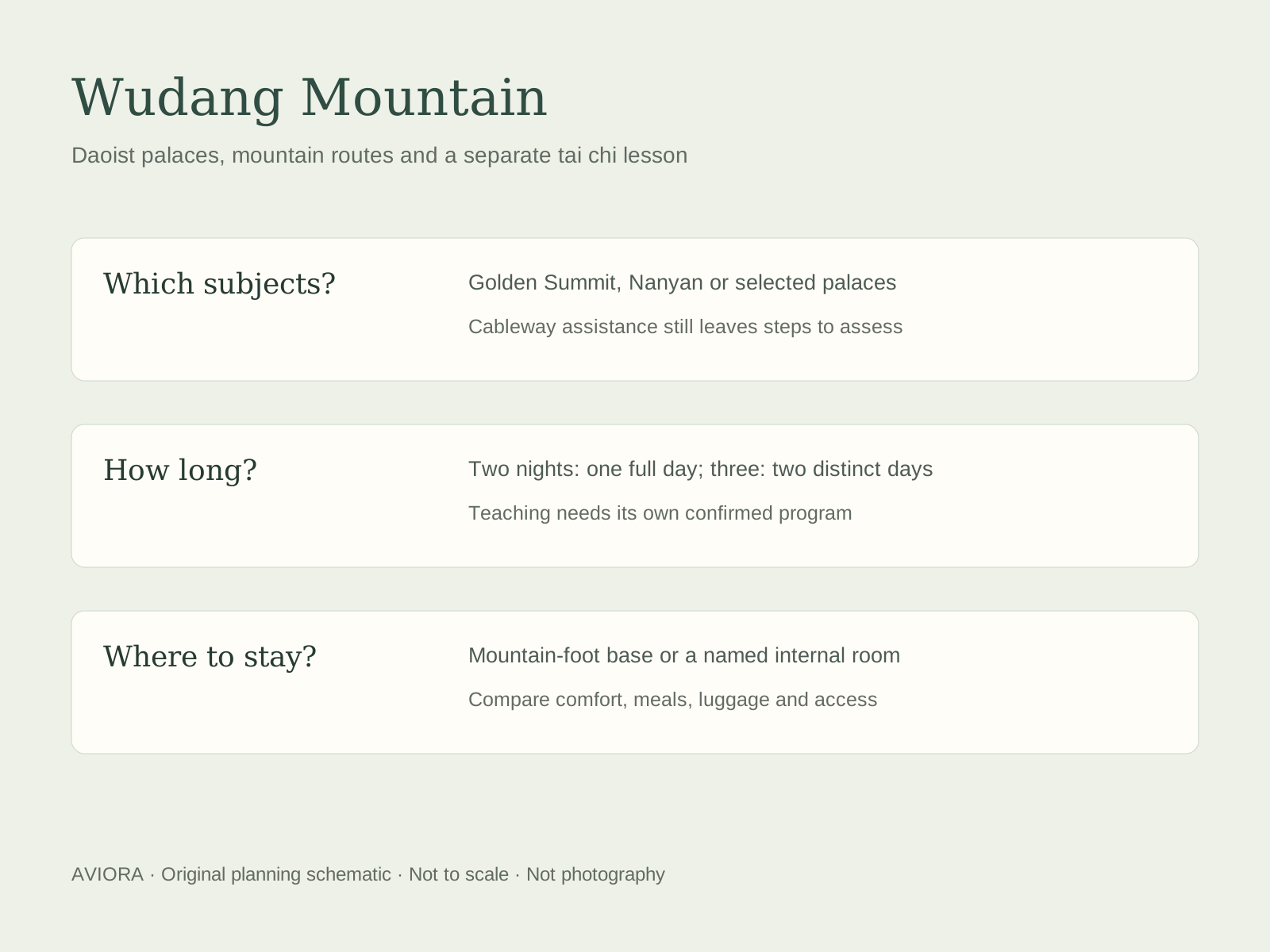
The Wudang Mountains (武当山), often called Wudang Shan or Wudang Mountain, form a Daoist sacred landscape near Shiyan in northwestern Hubei. The cultural reason to visit is the relationship between temples, palaces, mountain terrain and devotion to Zhenwu, rather than a promise of a martial-arts performance. For a first stay, choose a Golden Summit route or a selected palace-and-Nanyan day according to your interests and walking ability. A cableway can reduce ascent but does not remove the final steps or all other walking. Two nights give one focused full day; three allow two distinct days. A tai chi class is a separately arranged teaching service, not included in ordinary sightseeing.
How many days do you need in Wudang Mountains?
Allow two nights for one considered full day between arrival and departure, selecting the main mountain or architectural subject. Three nights give two different days, separating a summit route from a palace or Nanyan interest when current operations and fitness allow. A defined teaching session can replace another subject rather than be added after a full physical day. One night is selective. Longer training or retreat stays need an actual teacher, program, room and daily workload assessed; they are not a longer version of a standard temple tour.
Compare stays by number of nights
1 night / selective and transport-dependent
Choose one meaningful subject around actual arrival and departure. A late room arrival and early train do not support a full mountain day. Do not promise summit, Nanyan and a class merely because the overnight uses a Wudang address.
2 nights / one focused full day
Use the day for a suitable summit route or a considered cultural sequence, with meals and rest. Choose a room that supports the actual entry and return. A shorter route is a valid plan when it matches the guests, not an incomplete version of a summit itinerary.
3 nights / two distinct days
Separate the principal mountain route from another palace or Nanyan subject, or replace an outing with a confirmed introductory lesson. Review the combined stair load rather than treat each day's headline in isolation. Extra time should create depth and flexibility, not pressure to complete every named site.
Plan a tailored Wudang Mountains visit
Wudang can form a distinct Daoist and mountain chapter within a Hubei journey through Wuhan, or another regional route when dated connections and useful nights fit. Yichang's river-and-cruise planning is a different subject, with fixed embarkation requirements where applicable; do not compress a full mountain day before a tight ship check-in. Xi'an adds another historical and gateway context with its own complete connection. Qingcheng Mountain is a comparison for choosing a Daoist landscape or a separately defined retreat, not a nearby substitute. No matching published Wudang tour is recommended here. Share dates, gateways, cultural interests, walking limits and room or teaching priorities for a tailored plan.
A proposal should name the hotel and room, exact arrival gateway, public entrances, scenic transport, cableway where selected, remaining walking, guiding, admissions and meals. Explain whether descent retraces the approach or uses a different walking route; those are not the same physical day. A tai chi lesson needs a confirmed teacher, language, venue, duration and suitable content. Private guiding does not authorize closed halls, monastery accommodation, private rituals or filming of practitioners. Agree a worthwhile lower or shorter cultural alternative if weather or operation changes the main route.
This is a destination planning guide, not a fixed departure or a confirmed package. We check the route, accommodation, transport and guide availability for your dates before setting out the services and price in writing.
Choose the main route before selecting the room and daily schedule. A summit day includes entry, internal transport, the cableway if used, queues, final walking, food and return. Keep a different window for Nanyan or a substantive palace visit rather than append it automatically. Religious observance, weather and current visitor operation affect the sequence. A class needs time to learn and recover, not just a short demonstration fitted between transfers. Keep essential routes off an uncertain arrival afternoon.
01
Understand a Daoist palace landscape through Zhenwu devotion, buildings and mountain terrain
02
Choose Golden Summit or another substantial public route with the full physical effort assessed
03
Add a suitable tai chi introduction only when the teacher, language and content are confirmed
Suggested Wudang Mountains itinerary
What can you fit into your Wudang Mountains itinerary?
Arrival / first night
Complete the gateway and internal arrival plan
Reach the booked room using the actual station or airport road and any required scenic transport. Eat and rest. A modest orientation can fit useful hours, but keep the main summit or palace sequence away from an uncertain late arrival.
Full day 1 / the principal route
Choose the summit or a considered cultural day
Follow an assessed Golden Summit route with the cableway and remaining steps understood, or a shorter palace-led sequence that suits the guests. Allow internal transport, meals, rest and the complete return. Do not append a class and every distant temple by default.
Full day 2 / for a three-night stay
Give a second subject time of its own
Choose a distinct Nanyan or palace interest, or a separately confirmed introductory teaching session in place of another physical outing. Review the combined walking load and current operation. A suitable weather alternative should retain the cultural purpose without forcing an unsuitable high route.
Departure / onward Hubei or another gateway
Protect the complete connection
Allow bags, internal exit where relevant, the full road and a realistic station or onward embarkation margin. This outline is illustrative, not a published package or a guarantee of rooms, cableways, halls, teachers, ceremonies or current activities.
Spring and autumn are useful starting points for mixed architecture and mountain walking, with actual temperature and rain still important. Summer can bring heat, storms and busy travel dates; winter needs a serious review of ice, cold, transport and hotel operation. Upper routes can be colder, windier and less visible than the room's location suggests. Cableway operation and public routes depend on current conditions. A worthwhile shorter cultural plan should remain available when the main high route is unsuitable.
What affects the cost of a Wudang Mountains trip?
Compare room category and meals, complete gateway transfers, scenic-area admission and internal transport, selected cableway journeys, named palace charges where applicable and guide preparation. A cableway return differs from a long walking descent. Teaching, training equipment and special programs are separate services. A premium should buy an appropriate route, useful interpretation and comfortable arrangements rather than a guaranteed private master, empty summit, reserved ritual or access behind a closed door.
Getting there and getting around
How to get to Wudang Mountains and plan your stay
Arriving and connecting
Research dated services to the actual Wudang or Shiyan gateway and the complete final road to the booked property. An airport proposal needs the operating flight and full onward journey confirmed. If sleeping within the scenic area, verify current entry, transport and luggage arrangements before assuming an easy late arrival. Keep essential high routes away from uncertain arrival hours and protect a realistic return to the ticketed station or onward embarkation point.
Getting around
Current scenic-area rules determine internal transport and where vehicles can reach. Name the actual palace, cableway and walking sequence, with meals, seats, toilets and pickup allowed. A private driver and a culturally prepared guide provide different services. Choose the complete ascent and descent, not only the headline summit. In unsuitable weather, use an assessed shorter alternative rather than improvise on a closed or slippery path.
Walking and access
Cableway assistance does not make Golden Summit step-free. Assess the exact upper approach, stairs, uneven or wet surfaces and the full descent. A longer walking descent can be much harder on knees than returning by cableway. Nanyan has its own approaches and steps; palace visits also involve thresholds and standing. Review actual elevation exposure, fitness and health needs for the chosen route. Agree seating, toilets and a turn-back option. A private car does not remove scenic-area transport rules or all final walking.
What first-time visitors often underestimate
Choose the question first: Daoist architecture, a mountain summit, a cliffside sacred place or a genuine teaching session. You can combine interests with enough time, but they are not one standard activity. A well-explained palace visit can be worthwhile without the top, and a class deserves its own attention rather than a few rushed minutes at the end of a physical day.
Where to stay in Wudang Mountains
Compare a specific mountain-foot property for meals, luggage and transport with a named scenic-area room for its advantage on the chosen route. Internal locations, vehicle access and service quality vary: a scenic-area booking does not mean a summit hotel or effortless first access. A Shiyan city room is another gateway choice, with a separate road to Wudang. Check heating or cooling, hot water, bathroom, bedding, stairs, breakfast, dinner and the exact luggage approach. A Daoist-style or retreat label does not establish monastic accommodation, a qualified teacher or medical provision.
Compare hotel areas
Mountain-foot area / practical entry and meals
Choose the exact property for room facilities, dinner, luggage and the full route to the visitor entrance. A Wudang town address is not necessarily beside the right pickup point. Check quiet, heating or cooling, bathroom and early breakfast before choosing by a mountain-view image.
A named scenic-area property / a route-specific advantage
Assess its actual internal location, permitted vehicle approach, remaining bag walk and transport schedule. Compare facilities with the time gained on the main route. An inside-the-scenic-area label does not mean a summit bedroom, a luxury standard or guaranteed sunrise access.
Shiyan city / an independent gateway base
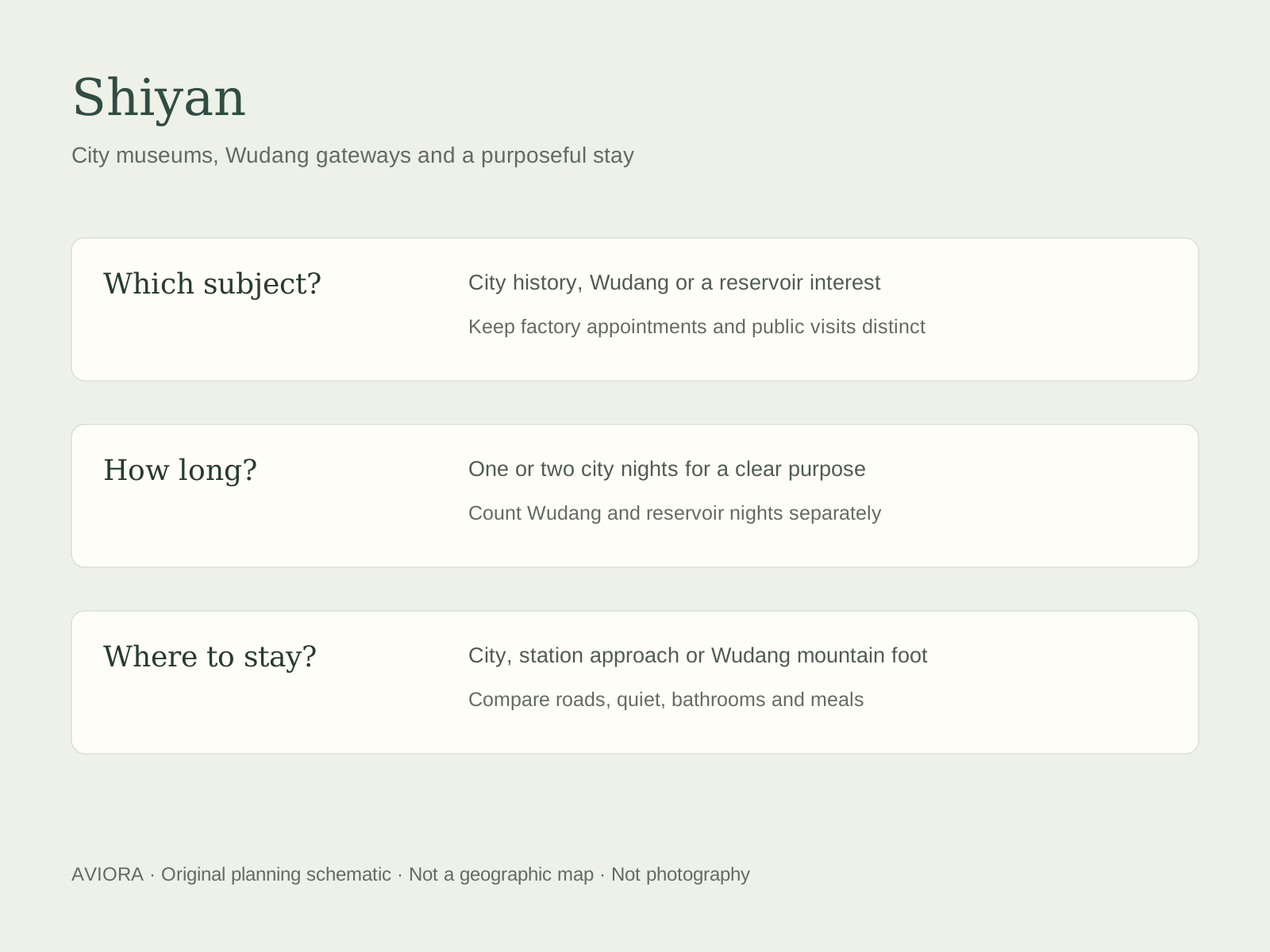
Use it for an actual flight, rail or city purpose, counting the full mountain-day road and return. A comfortable city hotel can serve a specific plan but is not interchangeable with a local Wudang base. Compare useful sightseeing time rather than the first transport segment alone.
A training-school room / only for an assessed program
Treat it as a different product decision. Check teacher, language, class size, daily workload, sleeping facilities, meals, rest and cancellation arrangements. A school photograph or martial-arts label does not establish teaching quality, private tuition or hotel-level comfort.
Should I choose Golden Summit, Nanyan, Zixiao Palace or Taizipo?
Choose Golden Summit / Jinding for the high mountain and Golden Hall setting, with the actual cableway approach, remaining steps and descent planned. Choose Nanyan for a distinct cliffside religious and architectural subject, not as an easier name for the summit. Zixiao Palace / Purple Cloud Palace and Taizipo offer other ways to read Daoist architecture and its relationship with the slope. A shorter cultural route can be worthwhile without reaching the top. Select one main subject and a realistic complement rather than require all four within every full day.
Taking the cableway and taking no steps are different promises
Ask for the actual route after the upper station, final summit approach and return. A walking descent may add substantial effort despite an assisted ascent. Choose the complete physical day with a useful turn-back alternative, rather than select a cableway icon and assume the mountain is accessible to every guest.
Nanyan is its own route, not a spare summit viewpoint
Its cliffside religious setting can be a strong reason to visit, but the approaches and connection to other paths need their own review. Do not use it as a generic easy substitute without assessing the actual walk. Explain the architectural and religious subject so a visit has meaning beyond another mountain photograph.
Daoist culture is broader than a martial-arts image
The palace landscape, Zhenwu devotion, historical patronage and continuing religious use provide a substantial cultural visit. A performance or lesson is another service. Avoid presenting worship as staged entertainment, promising private ceremonies or assuming all practitioners welcome close photography.
A short tai chi lesson is not a training retreat
An introductory session can teach a few principles or movements when the teacher and language suit the group. A serious training stay needs a defined program, physical workload, supervision and suitable accommodation. Neither should be sold as instant mastery, medical treatment or access to an unnamed grandmaster.
Historic construction dates belong to specific structures
The complex contains different periods, repairs and later presentations. At Golden Summit, discuss the Golden Hall's early Ming context and its particular material and form rather than apply one founding date to everything. A guide should separate original fabric, restoration and current religious use.
A mountain room earns its location through the real day
Compare room comfort, meals, luggage and transport with the time gained on the route. An isolated room with limited food or difficult bag access may not improve the trip. A high-end brief is best served by an appropriate base and informed pacing, with special access supported separately where genuinely available.
Culture and historical context
Read the buildings as part of a Daoist landscape
Wudang's architectural interest comes partly from the way religious buildings respond to the mountain. A palace approach, terrace, roofline or cliffside setting can explain a different relationship between movement, devotion and terrain. Zhenwu worship and historical patronage provide a more useful framework than describing every building as a martial-arts backdrop. At Golden Summit, the Golden Hall's material and early Ming context offer a specific subject for looking and explanation.
The mountain is also a place of continuing religious life and modern visitors. Distinguish worship, public interpretation, commercial training and staged performance rather than present them as one tradition available on demand. Follow current photography instructions and respect practitioners' space. A guide can offer a meaningful cultural account without promising private ceremonies, personal encounters or entry to monastic living areas.
Food and social life
Make lunch and recovery part of the mountain plan
A Wudang day needs a realistic meal and somewhere to sit, especially when steps or a longer descent are involved. Choose the actual dining stop around the route and appetite rather than schedule food only after every attraction has been completed. Ask which dishes are available and how much heat you want. Vegetarian food may be an interest where a suitable kitchen genuinely offers it, but a mountain or temple-area restaurant is not automatically vegetarian.
Check meat stock, pork, wheat, soy, sesame, nuts and shared preparation as relevant. A simple vegetable dish or a health-oriented menu does not establish allergy, coeliac or halal suitability. Serious requirements need a specific kitchen's confirmed capacity and an alternative. For an internal scenic-area room or training program, review both breakfast and dinner before booking rather than rely on distant outside restaurants after a physical day.
Wudang Mountains travel FAQ
Questions about visiting Wudang Mountains
Is Wudang Mountain worth visiting without martial-arts training?+
Yes. Daoist architecture, religious history and the relationship between buildings and mountain terrain can provide a substantial visit. A martial-arts performance or tai chi class is a separate choice, not a requirement for understanding the place.
How many nights should I spend at Wudang Mountain?+
Two nights give one selected full day; three allow two distinct days or a gentler pace. Choose the actual summit, Nanyan or palace route before deciding. A training retreat is a separate program, while one night is selective and depends on transport.
Does the Wudang cableway remove all the steps?+
No. It can reduce ascent but leaves a final visitor route and summit steps, with additional walking at other sites. Review the actual upper approach and complete descent. Returning by cableway and taking a longer walking descent are different physical days.
Should I stay at the mountain foot or inside the scenic area?+
Compare specific rooms using meals, comfort, luggage approach and the actual internal route. An internal property can provide a useful location but does not guarantee summit access or luxury facilities. A mountain-foot base may be simpler when its services and entry plan suit the trip.
Can I visit Golden Summit and Nanyan in one day?+
It depends on the actual route, operation, transport and guests' walking ability, but do not assume it is an easy standard day. Plan the full ascent, descent, meals and transfer sequence first. With two full days, separating the subjects can provide more useful time and less physical pressure.
Can I book a private tai chi lesson at Wudang?+
Research it as a separate service with a confirmed teacher, teaching language, venue, duration and suitable content. An ordinary mountain visit does not include it. A short introduction is different from a residential training program and should not promise instant mastery or medical benefits.
Is Wudang Mountain suitable for limited mobility?+
Suitability depends on the exact palace or mountain route and the room. Thresholds, stairs, standing and internal transport remain important even with a cableway. A shorter cultural sequence may be more appropriate, but requires an actual access review rather than a step-free assumption.
Which station should I use for Wudang Mountain?+
Compare dated services to the actual Wudang or Shiyan gateway with the complete road to the booked room. Wudangshan West and other station names are distinct pickups. Choose the whole journey rather than assume the mountain name on a ticket identifies the visitor entrance.
Share your dates, interests, arrival and departure cities, and any plans already booked. We’ll recommend an itinerary at a pace that suits you, with the arrangements and price explained before you book.