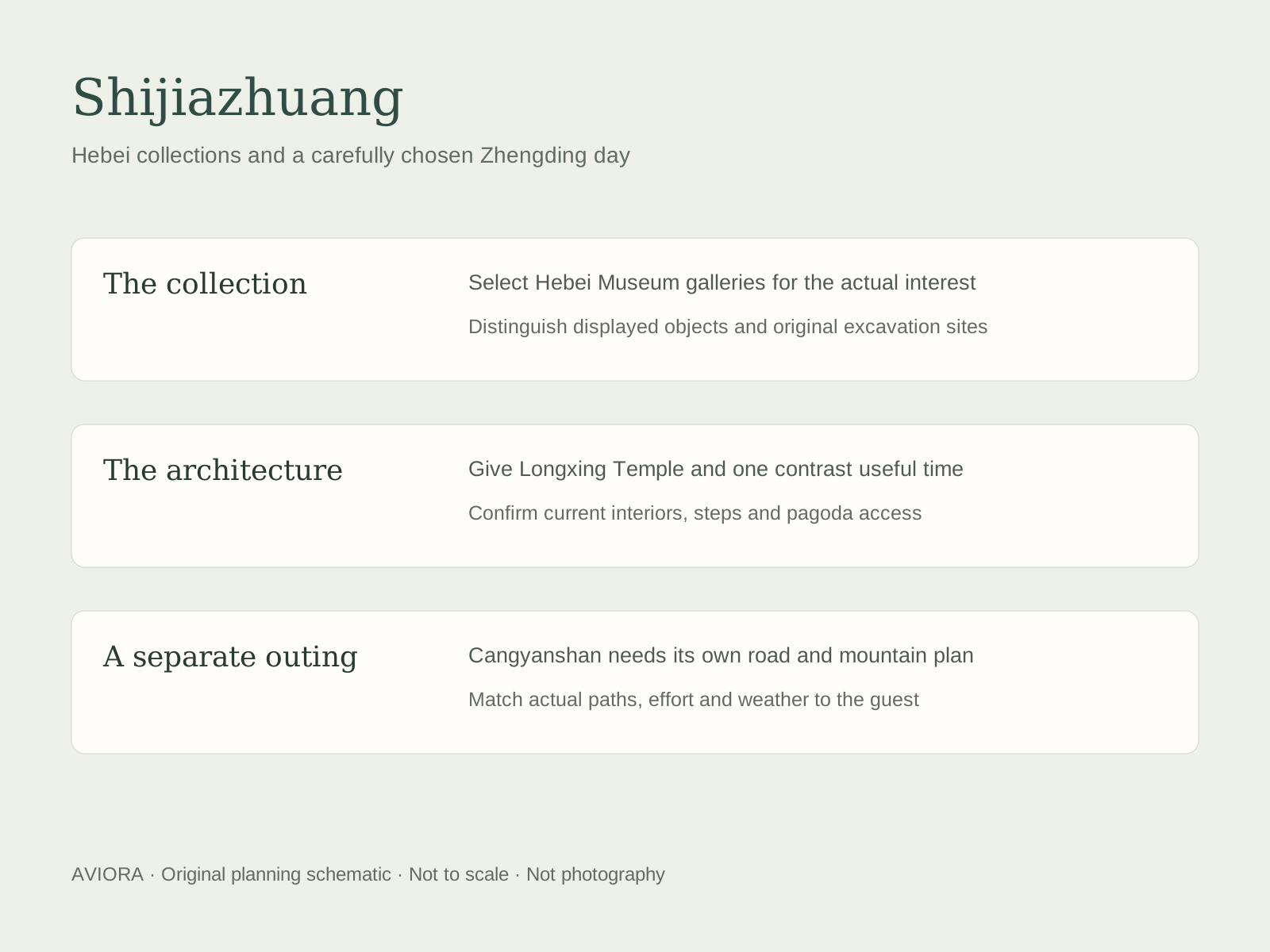
Choose Shijiazhuang for Hebei Museum and nearby Zhengding's architecture, with city or county-town hotel advice and a separately assessed Cangyanshan outing.
2–3 nights for collections and Zhengding architectureHistoric architecture, Buddhist sculpture and regional archaeology
Shijiazhuang (石家庄) is the capital of Hebei in northern China. Its strongest cultural case is a visit to Hebei Museum combined with a separately planned Zhengding architecture day. Choose two nights for one focused subject or three to give the collection and Zhengding useful time of their own. Zhengding is a separate county-town setting within the wider municipal area, not a pedestrian district beside every city hotel. Longxing Temple, other temple and pagoda sites, and Rongguo Mansion offer different kinds of visits. Cangyanshan is another mountain excursion. Shijiazhuang is a modern provincial city and transport gateway; its value comes from selecting these subjects well rather than describing the whole city as an ancient town.
How many days do you need in Shijiazhuang?
Two nights can support a focused Zhengding day or a collection-led city day when arrival and departure leave real time. Three nights allow both without squeezing the museum around an outlying temple visit and a train. A fourth night should follow a distinct interest such as a carefully assessed Cangyanshan excursion or a slower architecture program. One night is a valid gateway stay, but a late arrival and early departure do not provide a cultural day. Decide whether to sleep in the city or Zhengding from the actual visits, room quality and gateways rather than book extra daily returns by default.
Compare stays by number of nights
1 night: an honest gateway stay
Use a dependable room, meal and the correct onward transport. A short introduction can fit useful hours, but do not promise the provincial collection and a full Zhengding architecture route on an evening arrival and early departure.
2 nights: one focused cultural day
Choose the museum or a coherent Zhengding program based on interests. Protect explanation, lunch and rest rather than add every pagoda name. A real full day matters more than a long attraction list attached to narrow transport windows.
3 nights: collection and architecture in balance
Give Hebei Museum and Zhengding separate time with a suitable single base. A fourth night can support a distinct mountain interest or slower pace when appropriate. Review the route before adding hotel moves or repeated city-to-county returns.
Plan a tailored Shijiazhuang visit
Give Shijiazhuang and Zhengding useful time before connecting to Beijing, Chengde or Taiyuan as separate chapters. Beijing offers imperial-capital context, Chengde a different Qing court-and-temple setting, and Taiyuan another provincial collection and Jinci architecture. Compare actual dated services and complete hotel journeys rather than assume a shared northern-China label makes a short loop. No matching published Shijiazhuang itinerary is recommended here. Request a tailored plan with dates, gateways, principal art or archaeology interests, room needs and walking limits. Existing Beijing products do not automatically include Zhengding or Hebei Museum.
A proposal should identify each room and address, full gateway transfers, guide language, museum subject, named Zhengding sites and admissions. Explain which interiors can be visited and where only an exterior or authorized viewing position is possible. Specialist architecture or sculpture interpretation should have a real available provider and agreed content, rather than an implied curator meeting. Pagoda ascent, closed religious spaces, photography, private premises and conservation areas follow their own rules. A Cangyanshan visit needs a specific route and physical assessment. No product here includes every site merely because it appears in the guide.
This is a destination planning guide, not a fixed departure or a confirmed package. We check the route, accommodation, transport and guide availability for your dates before setting out the services and price in writing.
Anchor a collection day on the actual galleries and entry arrangement. Give Zhengding a coherent sequence centered on the principal temple, a contrasting site and lunch. Check current access before committing to several pagodas or halls. A Cangyanshan outing needs its own road and mountain block; it should not be inserted between a full temple visit and a departure train. Protect station transfers and the final approach to the next room. Keep an uncertain arrival modest rather than promise a famous object just before closing.
01
Understand selected Hebei collections through their original archaeological context
02
Give Longxing Temple and one contrasting Zhengding site time for careful interpretation
03
Choose comfortable city or county-town accommodation around useful local hours
Suggested Shijiazhuang itinerary
What can you fit into your Shijiazhuang itinerary?
Arrival
Reach the actual city or Zhengding room
Use the full gateway booking and agreed address, allowing a meal and rest. Keep any short introduction flexible. Do not make a timed hall or museum visit depend on uncertain arrival formalities and roads.
First full day
Give the principal cultural subject time
Choose a coherent Zhengding route centered on Longxing Temple or a relevant Hebei Museum collection day. Include explanation, lunch and manageable walking. Add a contrast only when it contributes something distinct.
Optional second full day
Add the complementary collection or architecture
With a third night, give the other principal subject useful time. A mountain excursion needs a separate further assessment rather than insertion into spare hours. Confirm all current access and any specialist service.
Departure
Continue with the complete regional transfer visible
Allow the actual station journey and next hotel's final approach. This two-night outline with an optional third night is illustrative, not a published package or a guarantee of museum objects, pagoda ascent, private halls or mountain conditions.
Spring and autumn can suit temple courtyards and city walks, with wind, rain and variable temperatures still possible. Summer can be hot and wet; time outdoor visits carefully and use an actually available collection as an indoor alternative. Winter is cold, making heating, daylight and possible ice on steps worth checking. Cangyanshan requires a separate mountain-weather decision. A seasonal recommendation does not guarantee quiet halls, dry paths or clear views.
What affects the cost of a Shijiazhuang trip?
Compare the actual room, breakfasts, full gateway journeys, guiding hours and language, named admissions and reservation support. City collections, a Zhengding architecture day and a mountain excursion have different service scopes. Clarify any internal transport or cableway proposed for a particular route, subject to current operation. Specialist interpretation or a host needs a real provider and clear inclusion. A premium should buy comfort, context and useful time rather than a guarantee of private halls, pagoda climbing or empty photographs.
Getting there and getting around
How to get to Shijiazhuang and plan your stay
Arriving and connecting
Use the full Shijiazhuang Zhengding airport or ticketed railway station and the actual room address. An airport arrival is not arrival at Longxing Temple, despite the shared county name. Include baggage, meeting, the road journey and check-in before judging usable time. For a late arrival, a proper meal and sleep may be more valuable than a rushed site entry. If continuing to another northern city, identify the final station and both hotel transfers before setting appointments.
Getting around
Combine planned city-to-Zhengding transport with coherent walks within the chosen sites. A vehicle cannot enter every courtyard or remove thresholds and standing. Establish real pickup points and a shorter route for limited mobility. Cangyanshan needs a separate full road and mountain plan rather than an informal extra. Respect current site, photography and worship rules, and use an available weather alternative rather than assume every museum or hall opens without reservation.
Walking and access
Temple routes can include thresholds, steps, courtyard paving and standing. Pagoda access may be exterior-only; if ascent is permitted, narrow or steep stairs need their own assessment. Museum galleries add sustained indoor walking. Cangyanshan involves a different mountain route, with steps and possible exposure to height; a private vehicle does not make the walk easy. Choose real entrances, seating, toilets and pickup, with a shorter alternative and current weather considered. Ask about stairs before choosing a site for a traveler with limited mobility.
What first-time visitors often underestimate
Begin with the actual interest: Buddhist sculpture, timber architecture, archaeological objects or a literary setting. They lead to different choices and none requires every attraction. A well-chosen collection day and a focused Zhengding route can make a strong two-day introduction. If the proposed stop is only for transport, say so clearly rather than inflate a short overnight into a comprehensive Hebei cultural tour.
Where to stay in Shijiazhuang
Compare an exact Chang'an or Yuhua city address for museum access, meals and a conventional room with a named Zhengding property for more useful time around the selected historic sites. The city districts are broad and Zhengding's accommodation is not all beside Longxing Temple. Check quiet, heating or cooling, bathroom, lift, luggage, breakfast and pickup. A Zhengding airport label refers to a gateway in the wider area, not arrival at a historic-town hotel. If a station-oriented room helps a particular departure, weigh that against the whole day's cultural travel rather than choose by one short transfer.
Compare hotel areas
A city Chang'an or Yuhua address / collections and urban comfort
Plot the precise museum entrance, dinner and gateway journeys. Check noise, temperature control, bathroom, lift and pickup rather than assume an entire district is central to every visit. A modern room can be more useful than a themed property that adds driving to both cultural days.
A named Zhengding property / useful time around selected historic sites
Compare the actual position with Longxing Temple, other chosen sites and evening meals. Heritage-style architecture does not establish the age of the building or room comfort. Check steps, sound insulation, heating, hot water, luggage and vehicle access; a town address is not proof that every visit is walkable.
A station or airport-oriented overnight / a specific connection
Use the full station or Shijiazhuang Zhengding airport booking and actual transfer. The airport's Zhengding name does not mean the terminal is beside the temple route. Weigh departure convenience against lost cultural time before moving rooms solely for one morning journey.
Should you prioritize Hebei Museum or Zhengding's Longxing Temple?
Choose Hebei Museum for selected regional archaeology and art galleries, with the actual display and reservation confirmed. Collections associated with the Zhongshan state and Mancheng Han tombs can provide relevant background when available; a museum visit is not a visit to those original excavation sites. Choose Longxing Temple for a site-based encounter with architectural arrangement and Buddhist sculpture, allowing time to look and understand the different historical layers. Add one contrasting Zhengding site when it teaches something new. Rongguo Mansion is a modern literary and screen-related attraction, not an interchangeable surviving ancient temple. A focused temple day and a provincial collection make complementary subjects rather than one rapid checklist.
Architecture becomes richer when sites are selected for contrast
Longxing Temple can lead a discussion of space, structure and sculpture. A further pagoda or temple should add a particular difference rather than repeat the same short description. Name the site and current access, distinguishing surviving material, later repairs and replacement work. An impressive age label does not establish that every visible feature comes from the earliest building phase.
A museum object is not the original archaeological site
Regional collections can explain excavated material and its context without making the excavation local to the museum. Mancheng and other sites have separate geography and access. Confirm the relevant gallery and current display rather than guarantee a particular treasure. A reproduction or interpretation should be described honestly, with enough time to understand its role.
Rongguo Mansion has a different reason to visit
Choose it for an interest in Dream of the Red Chamber, screen history or a constructed literary setting. It is a modern attraction and should not be sold as a surviving residence of a fictional family or as equivalent to Longxing Temple's historic fabric. Guests primarily interested in old architecture may prefer another carefully chosen subject instead.
A pagoda photograph is not permission to climb
Entry and ascent vary by site, conservation and current operation. Establish whether the experience is an exterior comparison, an accessible interior or a permitted climb. Narrow stairs, height and limited resting places can affect suitability. Private guiding does not override closures or authorize access beyond public areas.
Cangyanshan is a mountain choice, not another city courtyard
Choose the actual paths and intended temple or bridge setting, with remaining steps, exposure to height and return route assessed. Confirm any proposed transport and weather response. A dramatic photograph can conceal the physical effort; a shorter authorized route or a different cultural day may serve the guest better.
City, county town and airport are different starting points
A Shijiazhuang booking can refer to different urban districts, while Zhengding accommodation and the airport create other patterns. Plot the whole stay rather than choose the nearest place to one map pin. A direct arrival to Zhengding can be helpful when timing works, but it should not depend on a rushed final temple entry after an uncertain flight.
A northern-China architecture route needs actual nights
Beijing, Chengde, Taiyuan and Zhengding offer different historical settings. Pick a sequence supported by dated transport and useful stays instead of treating the provincial capitals as interchangeable transfer stops. The full connection includes luggage, station access and the next hotel's approach, not just a rail schedule.
Culture and historical context
Read the building and the object in their own settings
Longxing Temple offers the chance to understand how space, structure and sculpture work together within a site. A careful explanation identifies the particular building or figure, documented historical layers and what can be seen from the authorized route. Another temple or pagoda can add a comparison in form or material, rather than repeat a generic claim of antiquity. Repairs and later changes are part of that explanation, not details to hide behind an impressive founding date.
Hebei Museum supplies a different kind of context through objects removed from their original archaeological settings and interpreted in galleries. Relating a display to its place of discovery helps visitors understand both what it reveals and what a museum visit cannot show. Rongguo Mansion then offers a consciously constructed literary setting with a separate reason to visit. Good planning lets a guest choose among these modes of understanding without blurring historic fabric, excavated material and modern storytelling.
Food and social life
Use the regional meal to slow the day down
A meal in this part of Hebei can introduce grain foods, noodles, meat and vegetable preparations through the actual restaurant selected. Ask for a few well-explained dishes rather than a large generic banquet. Shijiazhuang city and a Zhengding day have different meal locations; a comfortable table near the chosen route can protect time for interpretation and rest. An appropriate warm lunch is particularly useful between exposed courtyard visits in cooler weather.
Discuss wheat, meat stocks, soy, nuts and shared equipment with the kitchen. A vegetable or tofu dish may still contain animal ingredients, and a regional label does not establish suitability for allergies or religious diets. Agree portions and any unfamiliar preparations before ordering. A cooking session or hosted meal requires consent and a real available provider; an ordinary restaurant visit can be valuable without being presented as access to a private household.
Shijiazhuang travel FAQ
Questions about visiting Shijiazhuang
Is Shijiazhuang worth visiting for culture?+
Yes when Hebei Museum and Zhengding's architecture match your interests. Two nights give one focused day and three allow the collection and temple-town subjects separate time. The city is a modern capital and gateway, so choose the specific cultural purpose rather than expect a preserved old town everywhere.
How many days do I need in Shijiazhuang and Zhengding?+
Three nights can provide two useful days for the museum and a focused Zhengding route. Two nights should prioritize one subject according to actual arrival and departure. Cangyanshan needs a further time and walking decision rather than automatic inclusion in the same short stay.
Is Zhengding in central Shijiazhuang?+
No. It is a separate county-town setting within the wider municipality. Plan the real hotel-to-temple journey and choose whether a city or Zhengding base works better. The airport's Zhengding name also does not mean immediate arrival at the historic sites.
What is the difference between Longxing Temple and Rongguo Mansion?+
Longxing is a historic Buddhist temple with an architectural and sculptural subject. Rongguo Mansion is a modern literary and screen-related attraction associated with Dream of the Red Chamber. Choose by interest and describe their different historical status honestly.
Where should I stay for a Zhengding visit?+
Compare a named Zhengding property for useful local time with a Shijiazhuang city room for museum access and urban services. Check exact site journeys, quiet, temperature control, bathroom, steps, meals and luggage. A heritage-style hotel label alone does not establish comfort or proximity.
Can I climb Zhengding's pagodas?+
Only where the specific site currently permits ascent and the route suits you. Some visits may be exterior-only. Confirm steps, interior access, height exposure and conservation rules before booking; a private guide cannot promise entry beyond public conditions.
Is Cangyanshan suitable for limited walking?+
It depends on the actual route, steps, slopes and available transport. Treat it as a separate mountain assessment, including the return and exposure to height. A short-looking map route or private car does not establish an easy visit; a different cultural day may be more suitable.
Does Hebei Museum include a visit to the Mancheng Han tombs?+
No. A museum display of excavated material is different from visiting the original archaeological location. Confirm current galleries and named objects, and plan any original-site excursion separately. A regional collection does not make every source site nearby or currently accessible.
Is a published Shijiazhuang private tour recommended here?+
No matching published product is recommended. Request a tailored plan with dates, gateways, principal art or history interests, room needs and walking limits. The proposal should identify actual sites, rooms and transfers, with any wider Beijing, Chengde or Taiyuan stay separately described.
Share your dates, interests, arrival and departure cities, and any plans already booked. We’ll recommend an itinerary at a pace that suits you, with the arrangements and price explained before you book.