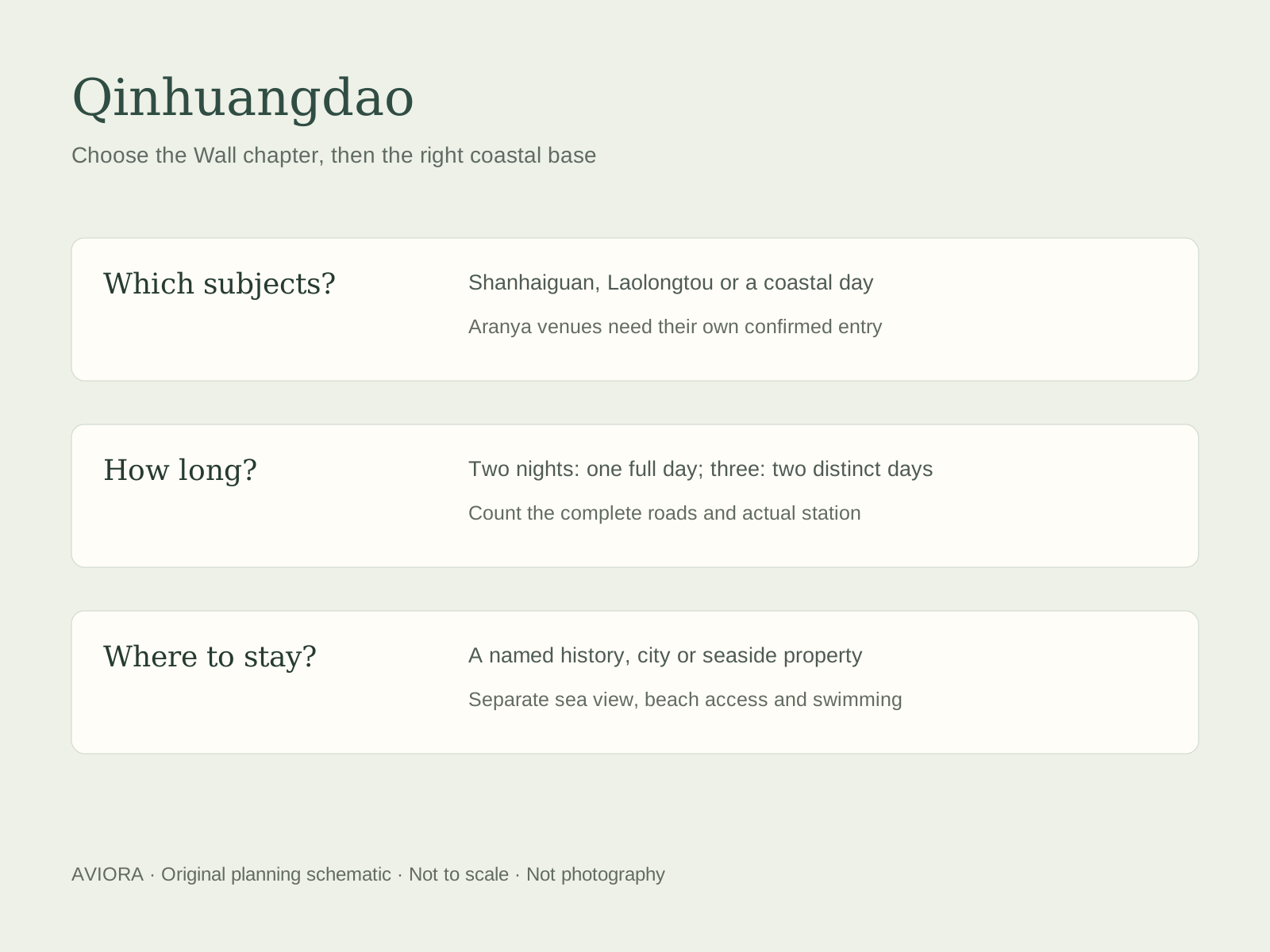
Plan Qinhuangdao around Shanhaiguan and Laolongtou, with clear Beidaihe versus city hotel choices and a separate, access-aware Aranya architecture decision.
2–3 nights for a focused history-and-coast stayGreat Wall history, coastal downtime and selected contemporary architecture
Qinhuangdao (秦皇岛) is a coastal city in northeastern Hebei on the Bohai Sea, east of Beijing. Its clearest cultural reason to visit is Shanhaiguan, where a major Ming Great Wall pass and nearby coastal defenses explain the relationship between mountain routes, settlement and the sea. Laolongtou, often translated as Old Dragon's Head, is a separate coastal site. Beidaihe offers another accommodation and seaside chapter southwest of the main city, while Aranya is a distinct contemporary resort-community destination farther along the coast. Two nights allow one focused full day; three can give the Wall history and coast useful time of their own. Choose the actual sites, hotel and transport before treating the municipal name as one compact beach resort.
How many days do you need in Qinhuangdao?
Two nights work for a selected Shanhaiguan-and-Laolongtou day when arrival and departure fit. Three nights add a different coastal day or more time at a well-chosen property. A longer resort stay needs its own reason, such as actual beach facilities, family downtime or a confirmed architecture interest. One night is selective. A Beijing return outing can be researched for a focused historical visit, but it is a weaker fit if you expect both substantial interpretation and an unhurried seaside break. Count the final transfers and useful hours, not just the train's advertised journey.
Compare stays by number of nights
1 night / one selective history chapter
Choose a focused subject when the actual trains and entry hours leave useful time. A late room arrival and early departure do not provide a full heritage day and a seaside holiday. Keep the property and meals practical rather than travel across the city for a brief beach photograph.
2 nights / one complete local day
Protect a well-paced Shanhaiguan-and-Laolongtou day when the route and walking suit the guests. Leave meals, interpretation and a realistic return to the room. A separate resort or architecture venue should not quietly consume the history time you expected.
3 nights / history and a different coastal day
Add actual property time, a suitable coastal route or a separately confirmed architecture interest. Decide whether one base or a purposeful move works better. More nights do not guarantee swimming weather, quiet beaches, a venue booking or clear morning light.
Plan a tailored Qinhuangdao visit
Qinhuangdao can add a distinct Great Wall-and-coast chapter after Beijing or Tianjin. Choose it for the contrast, not as another interchangeable Wall excursion. Chengde adds a different Qing estate-and-temple setting with a separate connection and useful nights. No matching published Qinhuangdao tour is recommended here. Request a tailored plan with dates, gateways, history or architecture interests, beach expectations and room priorities. Existing Beijing Great Wall products do not automatically include Shanhaiguan, Laolongtou, coastal accommodation or Aranya access.
A proposal should name each heritage site and actual visitor route, hotel and room, station pickup, full road days, guide language, admissions and meals. Explain whether walls, towers or buildings are open internally or viewed from outside. Confirm any Aranya venue, exhibition, accommodation-linked access or event separately with the responsible operator for the actual travelers and dates. A private vehicle, restaurant booking or hotel reservation elsewhere does not grant entry to every resort space. Swimming, sailing, birding, specialist architecture guiding and drone use need their own suitable conditions and confirmed service where available.
This is a destination planning guide, not a fixed departure or a confirmed package. We check the route, accommodation, transport and guide availability for your dates before setting out the services and price in writing.
Keep Shanhaiguan and Laolongtou as named visits with real entrances, travel, walking and lunch. Do not attach a distant resort venue simply because it appears on the same coastline. Summer demand and holidays can affect roads, rooms and the feel of popular beaches. A seasonal event or venue needs its actual admission arrangement, while a sea sunrise depends on weather and the chosen outlook. Protect the correct station transfer before departure and keep essential visits off uncertain arrival hours.
01
Understand Shanhaiguan as a fortified pass within a wider defensive landscape
02
Give Laolongtou its own coastal-history context and actual visitor route
03
Choose a seaside or confirmed architecture day that genuinely contrasts with the heritage visit
Suggested Qinhuangdao itinerary
What can you fit into your Qinhuangdao itinerary?
Arrival / the actual station and chosen base
Settle in without overloading the first window
Transfer to the booked room with luggage, meals and actual arrival hours allowed. A modest local orientation can fit when conditions support it. Keep essential heritage or venue entry off an uncertain late arrival rather than promise an important tower just before closing.
Full day 1 / a coherent pass-and-coast history day
Connect Shanhaiguan with Laolongtou
Use the selected currently open routes, with separate transfers, walking, interpretation and lunch. Explain the roles and restoration history of the actual structures. Choose a shorter useful option when steps, weather or guest needs make the fuller route unsuitable.
Full day 2 / for a three-night stay
Give the coast a different purpose
Enjoy actual property time and a suitable coastal route, or a specifically confirmed Aranya architecture interest when the full road and access fit. Swimming, exhibitions and performances are separate conditions. The day should remain worthwhile without clear sunrise light or a private beach atmosphere.
Departure / the complete onward connection
Allow the real final road journey
Reach the ticketed station or begin a separately confirmed Beijing, Tianjin or Chengde chapter with enough transfer margin. This outline is illustrative, not a published package or a guarantee of rooms, venue access, swimming, weather or current site operation.
Choose the season by purpose. Spring and autumn can suit a history-and-coastal-walking visit when the actual weather is comfortable, while summer is a common starting point for researching a seaside holiday and can bring high demand, heat and rain. Swimming needs current conditions and actual facilities, not a seasonal guarantee. Winter is a different cold-coast experience with potentially reduced resort services. Migration-season birding is a specialist interest requiring actual habitat, dates and guiding; it should not be promised as a routine sighting on every beach day.
What affects the cost of a Qinhuangdao trip?
Compare the specific room and season, breakfast, full station transfers, guide hours, named heritage admissions and any venue tickets or reservation services. A city history day and a resort day buy different experiences. Clarify pool, beach facilities, children's activities or event access rather than assume they follow from the room rate. A premium should deliver comfort, interpretation and useful location, not a guaranteed empty beach, clear sunrise, private Wall section or unrestricted architecture access.
Getting there and getting around
How to get to Qinhuangdao and plan your stay
Arriving and connecting
Choose the dated service and station that fit the actual base: Qinhuangdao / 秦皇岛, Shanhaiguan / 山海关 or Beidaihe / 北戴河. Include the complete road to the room or visitor entrance, luggage and useful arrival hours. An airport proposal needs a verified dated operating flight and full final transfer. Keep essential interiors, exhibitions and the main heritage subject off uncertain arrival windows, and protect a realistic return before an onward departure.
Getting around
Plan named road stages between heritage sites, the chosen coast and any separate resort venue. A private vehicle does not enter every pedestrian area, remove tower steps or confer venue admission. Agree parking, the final walk, toilets, seating, lunch and pickup. Beach outings need the actual permitted shore and current conditions, while hill walking and specialist photography require their own assessment. Avoid spending a whole coastal day crossing between properties chosen from unrelated photographs.
Walking and access
Wall stairs, tower access, courtyard paving and prolonged standing differ from a level promenade or sandy beach. Check the actual open route, gradients, seating and final vehicle access. A hill section such as Jiaoshan is a different physical undertaking from a selective pass visit. Coastal wind, wet paving, sand and summer heat can change effort. Agree toilets, pickup and a shorter worthwhile option. A private car does not remove the final steps or make every historic building and shoreline accessible.
What first-time visitors often underestimate
Ask whether the trip is primarily about Ming defensive history, seaside rest or contemporary architecture. Then choose the room and station around that purpose. You can combine two interests with enough time, but a pass tower, beach image and famous cultural building do not necessarily form one convenient day. A clear main subject and honest transfers make the coastal extension much easier to judge.
Where to stay in Qinhuangdao
Choose Shanhaiguan for a history-led chapter, a specific Haigang city property for practical meals and room comfort, or a named Beidaihe hotel when the seaside stay is central to the brief. These locations create different daily roads. An Aranya booking is a separate property-and-access decision. Check the actual beach or promenade route, room outlook, quiet, heating or cooling, meals, lift and pickup. Sea view does not mean direct sand access, and beach access does not establish swimming conditions. For a premium stay, confirm the room and services you will use rather than infer them from resort branding.
Compare hotel areas
Shanhaiguan / a history-led base
Check the actual approach to the chosen pass or town route, room quiet, bathroom, temperature control, dinner and luggage handling. A historic-town address does not prove an old building or heritage-room standard. Count the road to Laolongtou and onward station separately.
Haigang city or a named waterfront property / practical comfort
Compare the precise outlook, promenade access, meals, room category and daily transfers. A waterfront listing may serve a city stay rather than a sandy-beach holiday. Choose it for actual room and location benefits, with the correct arrival station and heritage road day mapped.
Beidaihe / a separately chosen seaside stay
Assess the exact property, walk to the coast, seasonal operation, noise, meals and any swimming facilities. The district name does not establish a private beach, lifeguards, warm water or a quiet resort atmosphere. Give the coastal purpose real time and count the road to Shanhaiguan.
Aranya / a specific accommodation-and-access proposal
Name the actual property, community location and intended venues, then confirm how access works for the dates and guests. A hotel booking should not be interpreted as a universal pass to every building, performance or exhibition. Check meals, booked view, beach facilities and final station transfer as part of the whole stay.
Should I choose Shanhaiguan, Laolongtou, Beidaihe or Aranya?
Give each a purpose. Shanhaiguan introduces a fortified pass, selected wall structures and town history. Laolongtou provides a different coastal-defense setting and the familiar Wall-meets-the-sea image. Beidaihe is a seaside base or selected coastal outing, not another Great Wall entrance. Aranya can suit a defined architecture, exhibition or resort interest only when the actual venue and entry arrangements are confirmed. A good short stay pairs a coherent history day with a distinct coastal interest; it does not require every famous photograph along the wider shoreline.
Shanhaiguan and Laolongtou are different visitor sites
The pass and the coastal defenses explain different parts of the Ming defensive landscape. They are not one entrance or a continuous short walk along the Wall. Name the actual route and what survives, what has been repaired or reconstructed and which spaces are open. A photograph of the sea-end structure does not describe the whole Shanhaiguan visit.
A famous Wall endpoint needs historical qualification
Laolongtou is commonly described as the Great Wall meeting the sea, and Shanhaiguan as a major eastern gateway of the Ming defensive system. Use that context without reducing all Chinese frontier walls across periods to one single line with one undisputed eastern end. Explain the selected structures and their historical role rather than turn a convenient slogan into a universal geographical claim.
A coastal room is not a swimming promise
The Bohai coast has a seasonal climate, and water conditions, designated areas and operating lifeguards need current review. Sea view, promenade access, sand access and supervised swimming are separate benefits. Choose an alternative coastal or indoor plan that remains worthwhile if swimming is unsuitable, especially for a family stay outside the warmer period.
Beidaihe and Aranya are not interchangeable resort labels
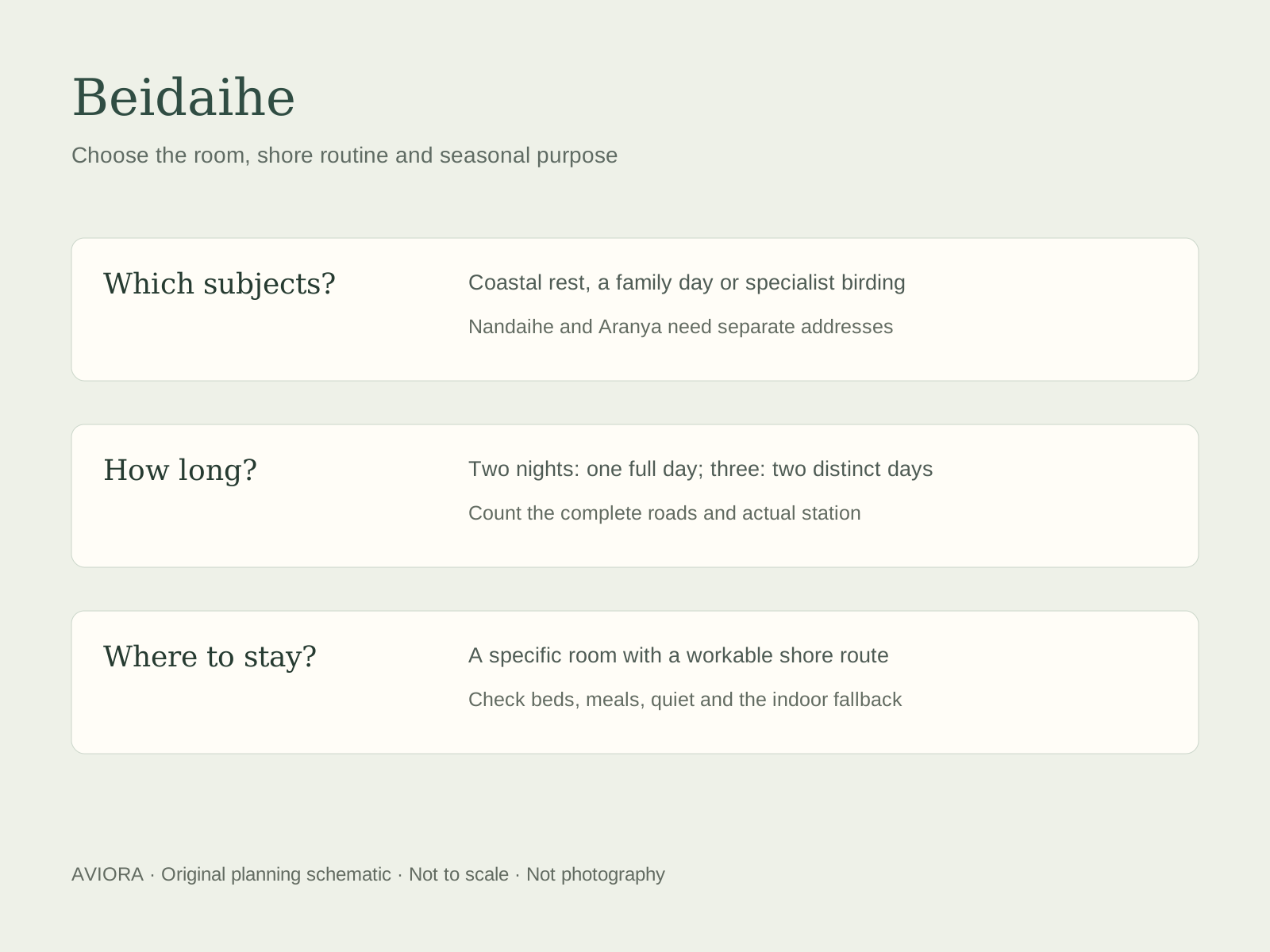
Beidaihe is a distinct district and seaside destination; Aranya is a separate contemporary resort-community decision in the wider coast's planning geography. Use the full property and venue addresses. An image labeled Beidaihe, Beidaihe New Area or Qinhuangdao may not identify the same beach or daily road pattern. Do not choose a hotel by a broad coastal tag alone.
Architecture photographs do not establish public entry
An exterior, an exhibition interior, a performance and a stay within a resort community have different access arrangements. Confirm the exact Aranya venue and dated admission before making it the reason for the trip. A social-media image, a cafe reservation or a general beach visit is not evidence that the guest can enter every library, chapel or cultural building.
A hill section of the Wall is another physical choice
Jiaoshan or a longer mountain route should be assessed separately from pass courtyards and a coastal viewpoint. Confirm the actual open section, steps, height exposure, current transport and weather. Do not use a relatively level sea-front image to imply that every nearby Wall experience is suitable for limited mobility.
Culture and historical context
Read a defensive landscape beyond a single famous image
Shanhaiguan and Laolongtou show why the relationship between mountain corridors, settlement and sea mattered to a defensive system. Their value lies in understanding the particular structures and terrain, rather than collecting another generic Great Wall photograph. Good interpretation distinguishes the Ming setting, later events, surviving fabric and modern restoration. A reconstructed coastal view can still be informative when its status is explained clearly instead of presented as an untouched ancient scene.
The wider coastal journey can then introduce a different history of seaside use and contemporary development. A modern cultural building, a beach property and an older town neighborhood tell different stories. Name the actual subject and respect the boundary between public space, a ticketed venue and a residential community. Specialist guiding or a hosted conversation needs a genuine available provider; architecture interest does not imply private access or permission to photograph residents.
Food and social life
Let a coastal meal be transparent and well timed
Seafood can be part of a Qinhuangdao meal for guests who want it, but the actual species, portion, price basis and cooking method should be clear before ordering. Coastal location alone does not establish freshness, sustainable sourcing or a fixed affordable menu. A few suitable cooked dishes, vegetables and a staple can make a comfortable lunch between heritage visits. Not every guest needs a seafood banquet to enjoy a seaside stay.
Clarify shellfish, fish sauce or stock, wheat, nuts and shared equipment where dietary needs matter. Serious seafood allergies require a confirmed kitchen's capacity and a workable alternative, not merely removal of visible prawns from a dish. Vegetarian, halal and other requirements also need specific venue assessment. Arrange breakfast and late-arrival food with the actual property, and keep meal time realistic rather than sacrifice it for another distant coastal photograph.
Qinhuangdao travel FAQ
Questions about visiting Qinhuangdao
Is Qinhuangdao worth visiting from Beijing?+
It can be for a focused Shanhaiguan-and-Laolongtou history chapter or a distinct coastal stay. Choose the actual sites, season, hotel and complete transfers. A quick return outing and an unhurried seaside break are different trips; a short train time alone does not supply both.
How many nights should I spend in Qinhuangdao?+
Two nights provide one focused full day; three can add a different coastal or confirmed architecture day. One night is selective. Longer stays should have an actual resort or specialist purpose. Count the final station transfers and useful local hours rather than hotel nights alone.
Are Shanhaiguan and Laolongtou the same place?+
No. Shanhaiguan's pass and selected wall or town route are distinct from Laolongtou's coastal-defense site. Name each entrance, current visitor route and transfer. They offer complementary historical subjects, not one shared entrance or a guaranteed continuous short walk along the Wall.
Where does the Great Wall meet the sea?+
Laolongtou, or Old Dragon's Head, near Shanhaiguan is the familiar coastal site associated with that description. Explain it within the Ming defensive landscape and distinguish surviving fabric from later restoration. The slogan should not be used to describe every historical frontier wall as one single line with one universal endpoint.
Should I stay in Shanhaiguan or Beidaihe?+
Choose a specific Shanhaiguan room for a history-led stay or a named Beidaihe property when the seaside chapter deserves time. Compare the actual room, meals, coast access and full roads. Neither address automatically provides the best base for every heritage site and resort venue.
Can I visit Aranya's buildings without staying there?+
Check current access for each exact venue, date and traveler before confirming the trip. Community entry, exhibitions, performances and accommodation-linked arrangements may differ. A photograph, cafe booking or hotel elsewhere does not establish permission to enter every cultural building or resort space.
Can I swim at Qinhuangdao or Beidaihe?+
Assess the actual season, current water and weather conditions, designated area and operating supervision. A sea-view room or beach walk does not establish safe or available swimming. Agree a worthwhile alternative if the conditions are unsuitable, particularly for children or a shoulder-season visit.
Which railway station should I use for Qinhuangdao?+
Choose the actual dated service and hotel route. Qinhuangdao, Shanhaiguan and Beidaihe stations serve different final journeys. Give the driver the full ticketed station and property address; a broad city or coast label does not identify the most convenient pickup for every itinerary.
Share your dates, interests, arrival and departure cities, and any plans already booked. We’ll recommend an itinerary at a pace that suits you, with the arrangements and price explained before you book.