Toisan heritage, emigrant-built streets and a separate island escape · South China
Taishan, Guangdong Guide: Toisan Heritage & Stays
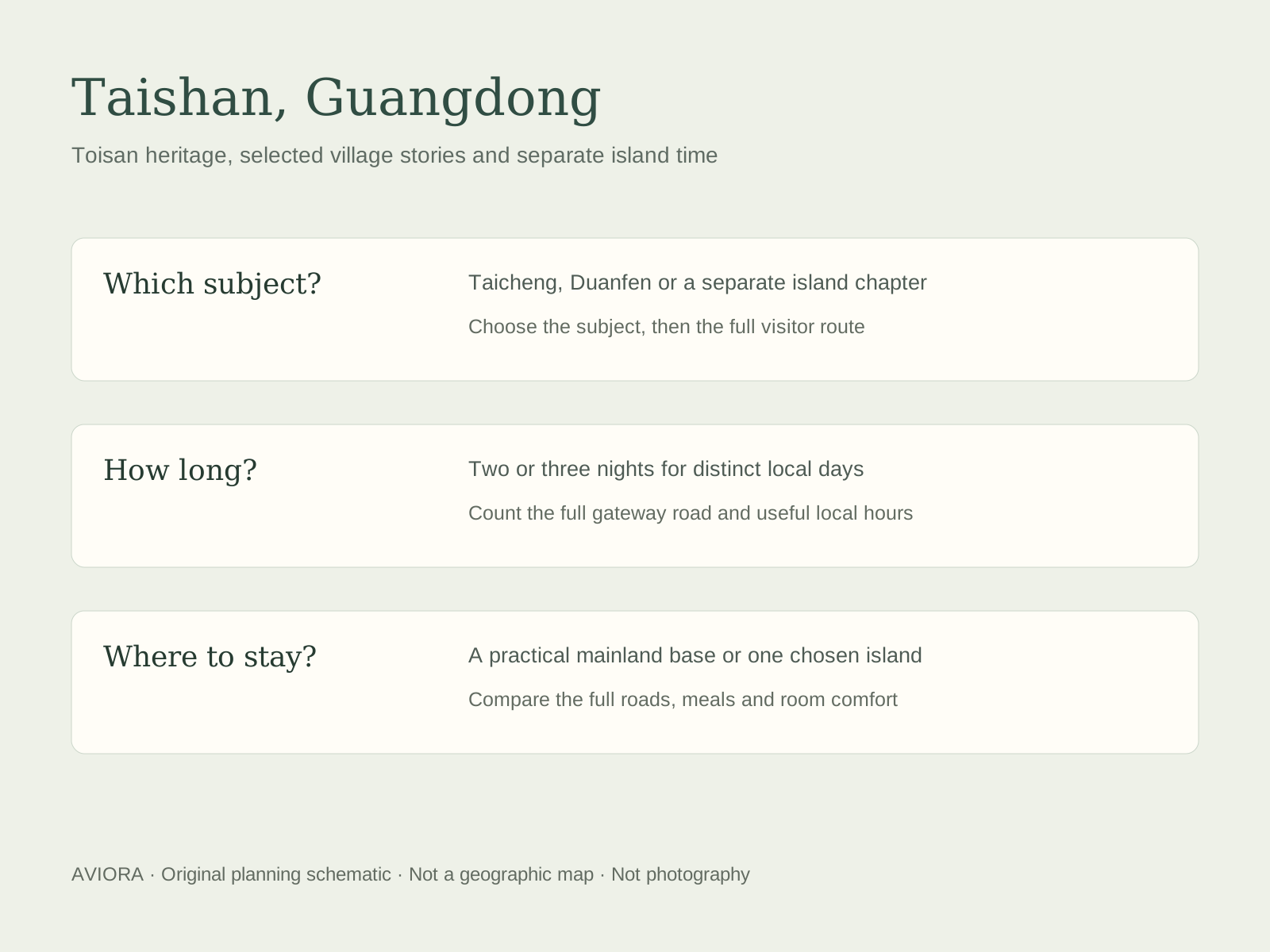
Explore Guangdong's Taishan, also known as Toisan or Hoisan, through Taicheng, selected emigrant heritage and carefully planned village or island stays.
2–3 nights for a heritage chapter; islands need their own timeChinese diaspora history, family-root interests and emigrant-era architecture
Taishan (台山) is a county-level city within Jiangmen in Guangdong, widely connected with overseas Chinese family histories. Toisan and Hoisan are names travelers may know from Taishanese-speaking families; older records may use other spellings. This is not Mount Tai / 泰山 in Shandong. Taicheng (台城) is the principal urban base, while Duanfen's Meijia Dayuan arcade complex and individual ancestral villages require their own roads. Shangchuan and Xiachuan are separate offshore island choices, reached through a different transport chain. Two nights give one full heritage day; three allow more considered city and village time. Begin with a clear interest and actual addresses rather than assume all Taishan-related places fit into one excursion.
How many days do you need in Taishan, Guangdong?
Choose two nights for one substantial Taicheng or selected rural heritage day between arrival and departure. Three can separate a museum and city introduction from a confirmed village or Duanfen route. Family-root research may need preparation before travel and flexible time on the ground. A brief island stay is a different chapter: two island nights can give one full day between transfers when dated sailings and conditions support it. Do not add both islands or an uncertain ferry return to an already full heritage day. Extra nights should add depth, comfort or useful contingency rather than a longer list of village names.
Compare stays by number of nights
1 night / a focused mainland stop
Choose a selected city or rural subject around actual transport and useful hours. A short stop can introduce one locality; allow additional days for family research or an island stay. Keep the route selective and the return comfortable.
2 nights / one full heritage day
Use one suitable mainland base and give the principal route time for explanation, a meal and questions. A modest arrival and departure protect the full day. Confirm any household appointment rather than build the visit around a presumed welcome.
3 nights or a separate island block / distinct chapters
Three mainland nights can separate city context from a substantial village route. An island extension requires its own dated transport and room assessment; it is not automatically included in a three-night mainland plan. Give each chosen chapter useful time rather than attempt both islands and every heritage stop.
Plan a tailored Taishan, Guangdong visit
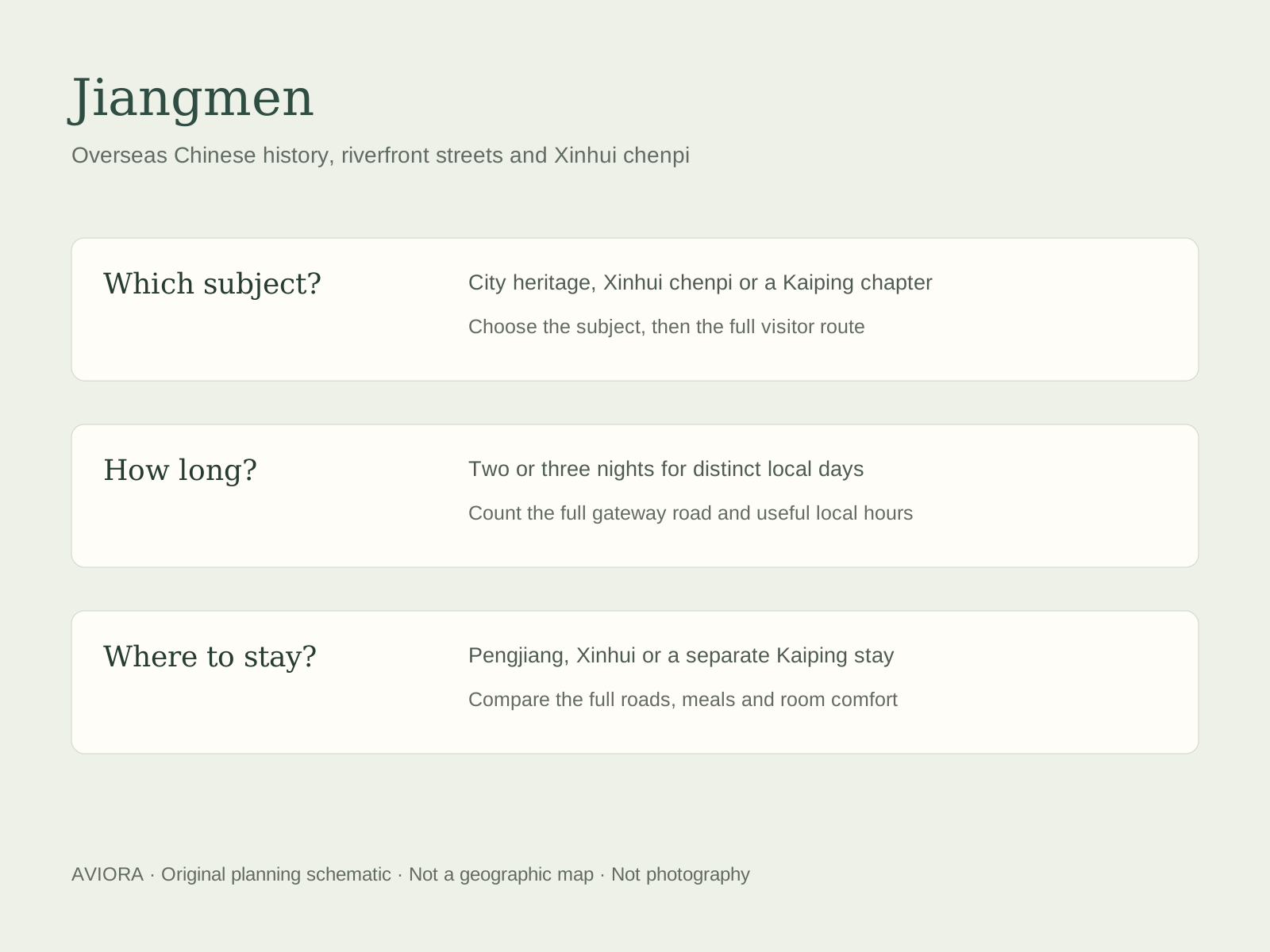
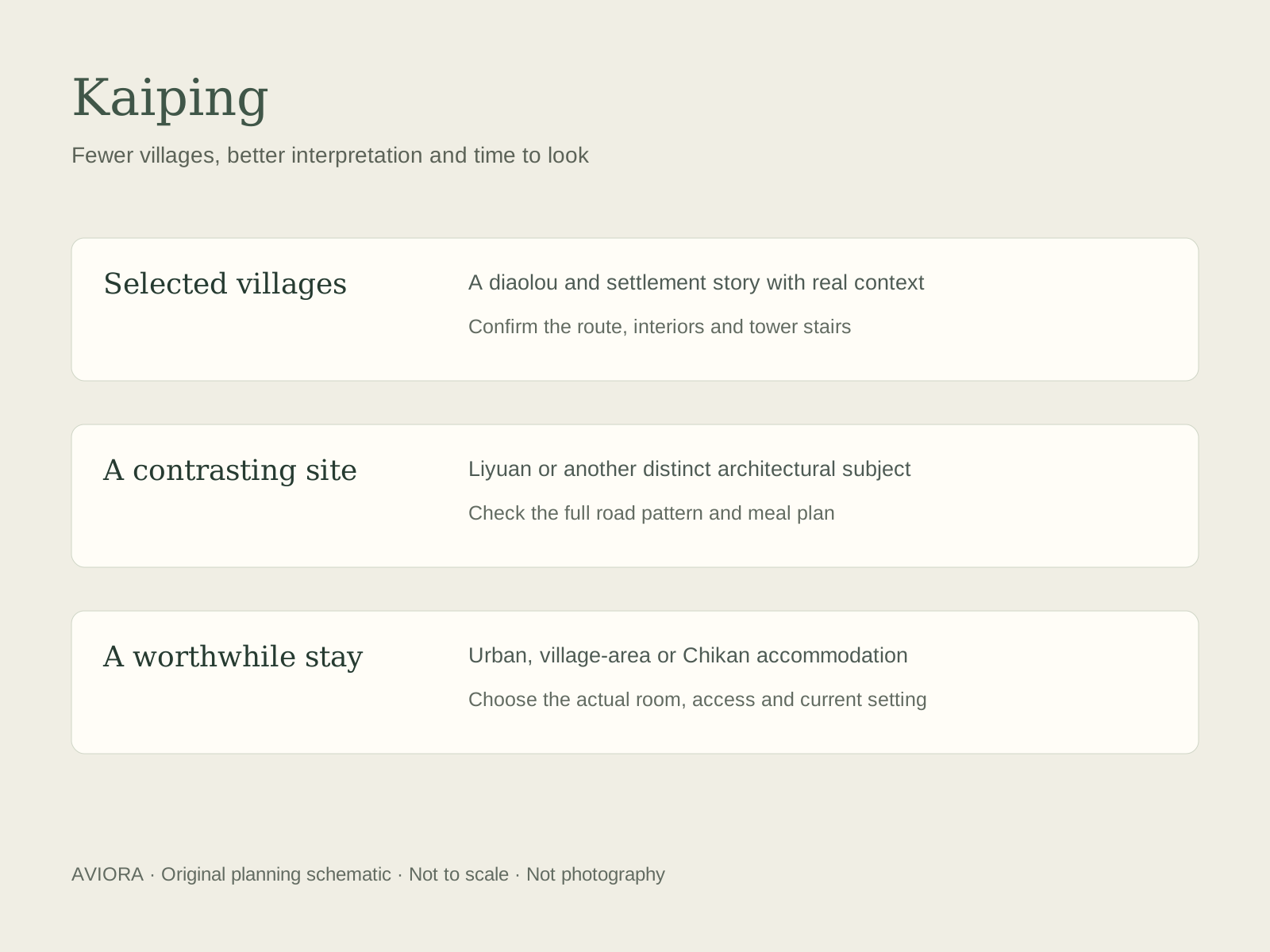
Jiangmen city provides a wider Wuyi museum introduction and a separate Xinhui chenpi interest. Kaiping develops selected diaolou village clusters and their architecture. Choose what each adds, compare actual roads and keep useful nights at each base. A shared emigrant history does not make every site interchangeable. No matching published Taishan product is recommended here. Share dates, gateways, walking and room preferences, plus whether the main purpose is architecture, family roots or island time, for a proposal with a clear route and defined research or host arrangements where needed.
A proposal should identify the actual room, gateway, complete transfers, guide language, selected public buildings, admissions and meals. If Taishanese interpretation matters, request it explicitly rather than assume an English- or Cantonese-speaking guide can interpret every family conversation. Genealogy, archives, document translation, willing relative contacts and private household entry require a separately agreed scope. An island chapter needs exact piers, dated sailings, vehicle and luggage arrangements on both sides, cancellation terms and a practical alternative. Private guiding does not guarantee records, living relatives or access to occupied buildings.
This is a destination planning guide, not a fixed departure or a confirmed package. We check the route, accommodation, transport and guide availability for your dates before setting out the services and price in writing.
Protect a full day for the principal heritage route. A confirmed village meeting or archive appointment needs its own time, translation and return plan. Do preliminary name and place work before arrival instead of spending the main sightseeing day searching for an address. For islands, count the mainland road, ticketing, waiting, sailing, disembarkation and hotel transfer. Do not base a critical same-day flight or long-distance train on an uncertain ferry return.
01
Read Taicheng and selected emigrant-era buildings through local history and evidence
02
Explore a defined Duanfen or ancestral-village subject with the right language support
03
Choose an actual island property and enough time to enjoy it as a separate chapter
Suggested Taishan, Guangdong itinerary
What can you fit into your Taishan, Guangdong itinerary?
Arrival
Settle and prepare the main heritage day
Complete the actual station road and check the booked room. Keep the first meal or walk modest. Review the selected village names, public access and language arrangements; do essential family-root preparation before travel rather than rely on a last-minute search.
Full day 1
Follow one coherent mainland story
Choose a city-led introduction or a substantial Duanfen or identified village route, with time for objects, buildings, questions and a regional meal. These are alternatives around the main interest, not a promise to cover every location and archive in one day.
Optional full day 2 / three-night mainland stay
Add a contrasting heritage subject
Use a second confirmed route to deepen architectural or family-history understanding, with appropriate language support. Keep uncertain research outcomes distinct from the agreed public visit. A city museum or another selected building should add a new question rather than repeat the previous day.
Departure or separately planned island extension
Protect the next connection
Allow breakfast, luggage and the full station or next-hotel road. If an island stay is chosen, use its separately confirmed pier, sailing, hotel and contingency plan. This outline is illustrative, not a published package or promise of relatives, records, sailings and private access.
Spring and autumn are useful starting points for mainland heritage walking, with actual rain, heat and holiday demand checked. Summer needs shade, water and shorter exposed blocks. Island dates require a separate review of weather, sailings, open hotel facilities and beach conditions; warm weather alone does not establish suitable swimming. Family and specialist appointments follow actual availability, not a standard tourism calendar. Keep a meaningful mainland alternative and clear transport terms when the sea chapter is important.
What affects the cost of a Taishan, Guangdong trip?
Compare actual room category, full vehicle and guide time, admissions, meals and separately defined specialist or research work. Island quotes should identify public tickets or another specified vessel arrangement, island-side transport and what happens after cancellations. Translation, archive fees, document copying and genealogy work are not automatically included in a sightseeing day. A premium proposal should explain interpretation, sleep, pacing and support rather than promise an ancestral discovery or private access without evidence.
Getting there and getting around
How to get to Taishan, Guangdong and plan your stay
Arriving and connecting
Check dated trains to the exact Guangdong station and its full road to the booked room. Use 台山 and the full Chinese hotel address so the booking cannot be confused with Shandong's 泰山 station. A Guangzhou, Foshan or Jiangmen rail segment excludes terminal access and the final village road. Island arrival adds the actual mainland pier, sailing and island-side hotel connection. Do not make an important household meeting or a critical onward connection depend on a tight arrival or ferry return.
Getting around
Plan by actual addresses and a coherent day: city context, a selected Duanfen route or a defined village purpose. Clarify guide language, vehicle waiting, bags and pickup. Public lanes, occupied interiors, private land and archives have different access arrangements. For islands, confirm which side provides the vehicle, who handles bags and what changes if a sailing is canceled. A mainland car and general guide do not automatically supply island transport or specialist family-history interpretation.
Walking and access
Selected arcade streets and village lanes can have uneven paving, thresholds, road traffic and limited seating. Upper floors and tower interiors may involve steep stairs or be unavailable. Review actual entrance and exit options for the chosen buildings. Island travel adds queues, boarding steps or ramps and luggage handling; a beach hotel photograph says little about the approach. Agree a worthwhile shorter route and a comfortable seated break rather than infer accessibility from a city or island label.
What first-time visitors often underestimate
If family roots matter, say so before the itinerary is fixed. The preparation and language needs differ from an architecture-focused visit. If islands matter, choose the actual property and full transfer before adding them to the mainland route. A few well-explained places can make a more personal stay than a long list of villages, towers and beaches with little time at any of them.
Where to stay in Taishan, Guangdong
Compare an actual Taicheng hotel for meals, services and heritage outings, a named rural property only when it improves a specific village plan, and a separate Shangchuan or Xiachuan room for an island-led stay. Check quiet, bathroom, temperature control, breakfast, luggage and final vehicle access. Taishan station is a gateway, not the address of every ancestral village. An island booking also needs the mainland pier, sailing, island-side transfer and final hotel road. A beach view does not establish direct sand access, supervised swimming or a high-service resort.
Compare hotel areas
Taicheng / practical mainland services
Compare exact hotels for quiet, bathroom, temperature control, breakfast, dinner and pickup. This can support several distinct heritage outings without moving rooms. The best station approach and the best village approach may point to different hotels; compare complete roads.
A named rural base / one specific heritage purpose
Consider only when the actual room and location improve a selected village or Duanfen plan. Check evening food, dampness, noise, luggage and vehicle access. Staying nearby does not establish resident-hosted access or that the room itself is a preserved historic house.
Shangchuan or Xiachuan / a separate island stay
Choose one island and an actual property around the intended beach and downtime. Feisha and Wangfuzhou refer to different island-area choices. Review booked room, beach approach, meals, open facilities and the full pier transfer. Sea views, beach access and swimming conditions remain separate questions.
Should I choose Taicheng, a village route or the islands?
Choose Taicheng for a practical city base and an introduction to local and emigrant history. Choose a selected village or Duanfen's Meijia Dayuan when a particular building, street or family question provides the purpose. Choose Shangchuan or Xiachuan when the actual beach property and island time justify a separate stay. These are different experiences. With one full day, prioritize one coherent heritage route. With more time, add a genuinely different chapter and account for the complete ferry and road chain before promising a coastal extension.
Toisan, Hoisan and Taishan need one clear place identity
Family records and community usage may preserve different spellings, pronunciations and historic place names. Keep the original characters and the exact township or village wherever possible. An English spelling alone may be ambiguous. Guangdong's 台山 is different from Shandong's 泰山, even though both can appear as Taishan in Latin letters.
A surname is a starting clue, not a completed family history
For an ancestral interest, begin with the guest's chosen documents, names, village references and known relationships. Record uncertainties rather than resolve them by guesswork. A useful proposal defines preliminary research, translation, permissions and how findings will be reported. Neither a shared surname nor a family story guarantees a particular lineage, an available archive or living relatives willing to meet.
An emigrant-built arcade complex differs from a diaolou cluster
At Meijia Dayuan, focus on street organization, covered pedestrian space, façades and what reliable evidence explains about overseas connections. Do not assign an individual migration story to every building. Compare it with a selected Kaiping village when the architectural difference is the point; a similar decorative detail does not place a Taishan building within Kaiping's UNESCO property.
A local-language need should be specified early
Taishanese belongs to the Yue language landscape but should not be treated as interchangeable with every form of Cantonese. Ask what language an actual host uses and what the guide can interpret. A fluent sightseeing introduction and careful translation of family names or an oral history are different tasks. Recording a conversation requires the speaker's agreement.
Island time needs a complete transport chain
Shangchuan and Xiachuan are separate islands. Review the actual sailing and mainland approach, often discussed through Shanzui / 山咀港, and confirm the correct pier and island-side transfer for the booking. Weather and operations can change the connection. Choosing one suitable property and enough time there usually adds more value than spending a short stay trying to collect both islands.
Culture and historical context
An overseas connection becomes meaningful through a particular story
Taishan's significance to Chinese communities overseas is a reason to look more carefully, not a reason to assign every building the same history. A selected museum object, arcade street or village structure can connect work abroad, remittances, return and family life when the evidence is specific. Ask who built or used the place, which source supports the explanation and how the building changed later. Meijia Dayuan offers a street-and-arcade subject distinct from a rural diaolou cluster. The comparison is strongest when a guide explains the visible plan and documented use rather than relying only on decorative resemblance.
For some visitors, the same landscape is personal. A village name may survive through an older pronunciation, a handwritten character or a relative's memory. Preserve those clues and their uncertainty. Good preparation separates identification, documentary research and a possible visit; it does not turn a tentative match into proof. A respectful encounter may involve public village space and a conversation with a willing participant, or it may remain a careful historical walk. Its value does not depend on promising a family reunion or entering a private home.
Food and social life
A rice dish and a coastal meal offer different local questions
Taishan-style yellow-eel rice, often called huangshan fan / 黄鳝饭, can provide a concrete food interest for guests who enjoy it. Ask how the kitchen prepares the eel, whether small bones may remain, how the rice is finished and what sauces or garnishes are used. The name refers to a regional preparation rather than one identical recipe. Choose a suitable portion with vegetables and other dishes instead of treating a substantial rice dish as a quick snack before another full meal. Guests who prefer not to eat eel should have an equally considered alternative.
On a coastal or island stay, agree the seafood species, portion or weight basis and any cooking fee before ordering. A live display does not establish local wild origin or a particular sustainability claim. Check bones, shellfish, soy, wheat-containing sauces, peanuts, sesame and shared preparation where relevant. Island arrival time matters for dinner: confirm the actual kitchen and meal plan before the final transfer. Good food, comfortable seating and an unhurried return are more useful than another detour for a famous restaurant.
Taishan, Guangdong travel FAQ
Questions about visiting Taishan, Guangdong
Is Taishan in Guangdong the same as Mount Tai?+
No. Taishan city / 台山 is in Guangdong within Jiangmen municipality. Mount Tai / 泰山 is in Shandong near Tai'an. The Latin spelling can look the same, so use Chinese characters, province and exact station names when booking.
Are Toisan and Hoisan names for Taishan?+
They are common spellings associated with Taishan in Guangdong and Taishanese-speaking communities. Family records can use additional historical forms. Keep original characters and the exact village or township to resolve ambiguity rather than rely on one English spelling.
How many nights should I spend in Taishan?+
Two nights give one full mainland heritage day; three allow separate city and selected rural chapters. Genealogy may need advance research and flexible time. Island stays require their own transport and useful nights rather than an automatic addition to the mainland schedule.
Can you include a visit to my ancestral village?+
It can be proposed after the place is identified and current arrangements are checked. Share only the names and documents you choose to use, ideally with original Chinese characters. Public access, research, translation and willing family contacts need separate scope; a visit cannot guarantee a lineage finding or private household invitation.
Where should I stay for Taishan heritage visits?+
Compare a Taicheng hotel with a particular rural property according to the main route. Check quiet, bathroom, climate control, meals and complete roads. A room's Taishan address does not place it near every village, station or island pier.
Should I choose Shangchuan or Xiachuan Island?+
Choose by the actual property, intended beach, room standards, available facilities and complete dated transport. Shangchuan's Feisha area and Xiachuan's Wangfuzhou area are different stays. Neither island name guarantees swimming, quiet beaches or a high-service resort; a short visit usually benefits from choosing one.
Which published Taishan tour is recommended here?+
No matching published product is recommended. Request a tailored proposal specifying the room, complete transport, public heritage route, language needs, meals and any separately confirmed research or host arrangements. The sample outline is not a package or a genealogy guarantee.
Share your dates, interests, arrival and departure cities, and any plans already booked. We’ll recommend an itinerary at a pace that suits you, with the arrangements and price explained before you book.