Discover Ningbo through Tianyi Ge's library culture, museum architecture and regional food, with clear choices on city hotels, temples and Dongqian Lake.
2–3 nights for city culture; add useful time for a lake stayArchitecture, book culture, maritime history and a slower Zhejiang route
Ningbo (宁波), written Ningpo in older English sources, is a port city in eastern Zhejiang, south of Hangzhou Bay. For a cultural visit, its strongest combination is Tianyi Ge's book-collecting tradition, Ningbo Museum's contemporary architecture, maritime history and a distinctive local table. Two nights give one selected city day; three allow two different cultural days. Dongqian Lake is a separate inland-lake base, not a sea-beach resort beside every city hotel. Choose Ningbo for these specific subjects rather than as a generic coastal stop or a substitute for Hangzhou's West Lake.
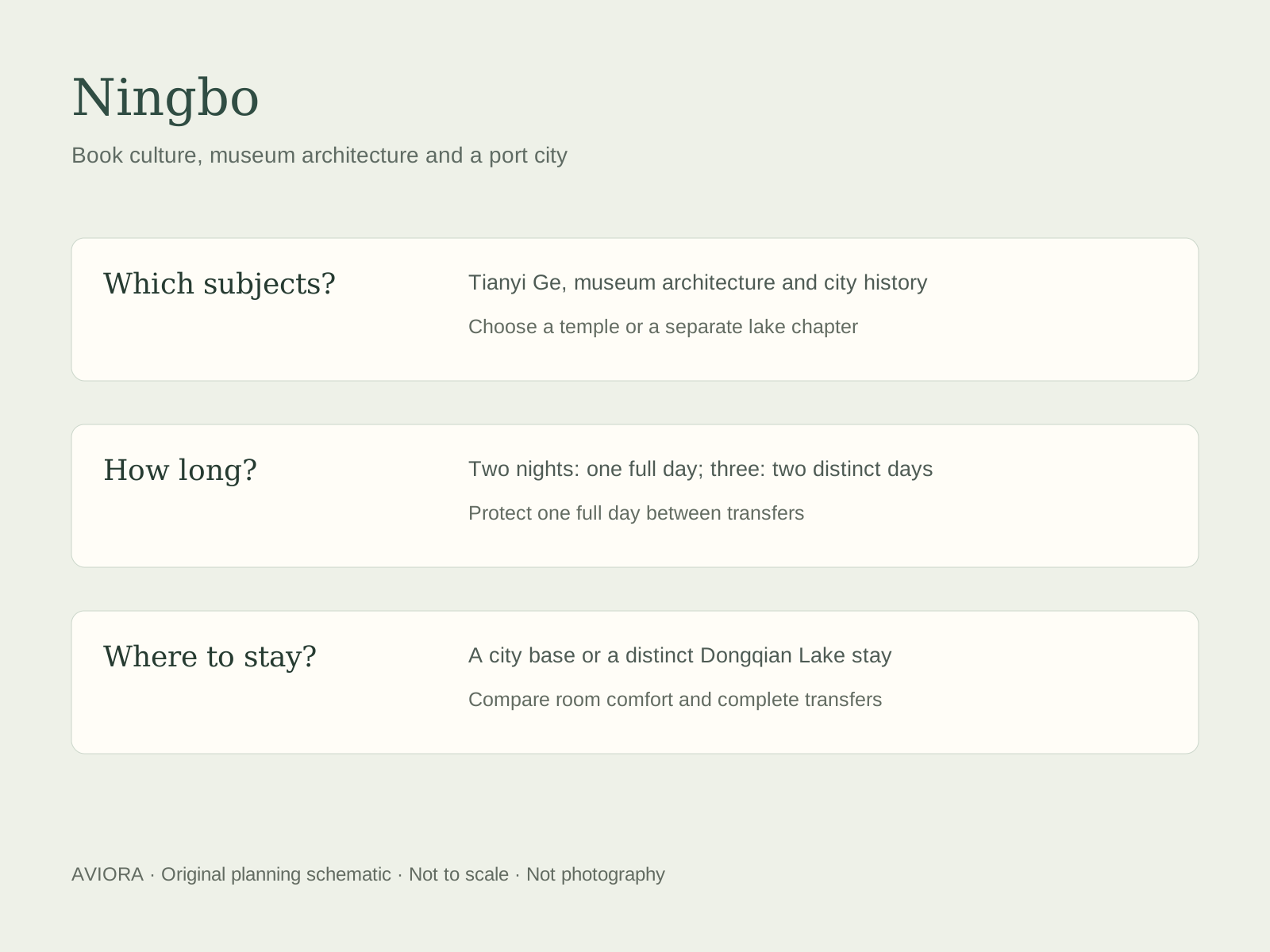
How many days do you need in Ningbo?
Allow two nights for one focused full day, usually choosing Tianyi Ge and a complementary city subject with a good meal. Three nights can add a substantive Ningbo Museum visit or a separately planned temple interest without squeezing everything between transfers. A Dongqian Lake stay needs enough usable time at the property and surrounding landscape to justify its location. One night is selective; more nights make sense for defined architectural, religious or regional interests rather than an assumption that every coastal attraction is nearby.
Compare stays by number of nights
1 night / one selective subject
Useful when transport leaves enough time for a meaningful Tianyi Ge or museum visit and a meal. Protect the essential public route from uncertain arrival hours. A late room arrival followed by an early departure is a transport stop, not a complete cultural stay.
2 nights / a focused city chapter
Give one principal institution and a complementary city walk a full day, with time to understand the subject and enjoy lunch. Add a modest arrival or departure interest only if the real hours work. Do not promise a lake resort stay and several outlying temples within the same city day.
3 nights / two different cultural days
Separate the library and central-city story from a substantial museum visit or selected temple excursion. Choose a comfortable city base to avoid unnecessary packing. If moving to Dongqian Lake, account for the lost sightseeing time and protect useful hours at the property.
A longer lake-led stay / make the setting worthwhile
Add time for an assessed Dongqian Lake property when rest, a particular room or an actual local activity is part of the brief. Check meals, shore access, indoor alternatives and season. Extra resort nights should deliver a real benefit rather than become a distant base for daily city transfers.
Plan a tailored Ningbo visit
Ningbo can add a material, maritime and architectural chapter after Hangzhou or Shaoxing, with Shanghai as another gateway when the actual connection fits. Linhai offers a different historic-town and city-wall subject farther south and needs its own nights and journey. Putuoshan belongs to a separate Zhoushan island and ferry plan, not an included Ningbo neighborhood outing. No matching published Ningbo tour is recommended here. Share dates, gateways, architectural and cultural interests, walking needs and room priorities for a route with clear inclusions.
A proposal should name the hotel and room, arrival gateway, complete transfers, public library-museum route, selected galleries or temples, guide language, admissions and meals. Define whether architectural interpretation comes from a suitably prepared guide or a separately available specialist. Rare-book handling, stored collections, architect meetings, working port visits, private worship spaces and hosted meals need their own permission and arrangements where available. Agree a useful alternative if a core interior is unavailable, and distinguish a lake hotel stay from a promised boat or activity program.
This is a destination planning guide, not a fixed departure or a confirmed package. We check the route, accommodation, transport and guide availability for your dates before setting out the services and price in writing.
Place the institution that matters most in a reliable opening-hours window. Tianyi Ge rewards a thoughtful public route; Ningbo Museum deserves time for the building and selected collections rather than a brief facade stop. Keep meals and rest between subjects instead of crossing the city repeatedly. An outlying temple day or lake move needs its own complete journey. Check closures and current exhibitions before booking a specialist-led day around one interior.
01
Understand book collecting and preservation through Tianyi Ge's public visitor route
02
Read Ningbo Museum's architecture alongside a selected regional collection
03
Choose a port-city walk and local meal, or a deliberately separate temple or lake chapter
Suggested Ningbo itinerary
What can you fit into your Ningbo itinerary?
Arrival / first night
Settle into the chosen city base
Complete the transfer to the booked room and take a relaxed meal. A short river orientation can fit if arrival allows, with the evening character honestly matched to the guests. Leave the principal library or museum visit for reliable public opening hours.
Full day 1 / books and the city
Connect Tianyi Ge with a port-city perspective
Give the available Tianyi Ge public route proper interpretation, followed by a regional meal and rest. Add a selected Sanjiangkou or Laowaitan walk for a different urban layer. Choose the route by interest and weather rather than append a distant temple after every central stop.
Full day 2 / for a three-night stay
Choose architecture or a distinct religious chapter
Use a substantial Ningbo Museum visit to combine building and collections, or choose a separately planned temple route with its approach and walking assessed. A move to Dongqian Lake is another option when additional nights protect useful resort time. No plan requires all of these choices together.
Departure / the actual onward route
Protect the complete connection
Reach the ticketed station or airport with the full final transfer allowed, or continue to another independently planned Zhejiang chapter. This outline is illustrative, not a published package or a guarantee of rooms, exhibitions, rare-book displays, ferry services or specialist access.
Spring and autumn are useful starting points for mixed city walking, temples and a lake setting, with rain still possible. Summer can bring heat, humidity and disruptive coastal weather, so an indoor cultural subject and flexible outdoor sequence matter. Winter requires a review of room heating and damp-weather comfort rather than an assumption of a warm coastal holiday. For ferry-dependent extensions, check the current operator and conditions separately. Museum and library access depend on institution schedules as well as season.
What affects the cost of a Ningbo trip?
Compare the exact room, breakfast, complete station or airport transfers, guide language and subject preparation, named admissions and meals. A lake property can add road time to city cultural visits; a temple excursion has a different vehicle scope from a central day. A premium should buy comfortable timing, sound interpretation and reliable facilities rather than unverified rare-book access, architect encounters, private temple ceremonies or a working-port tour.
Getting there and getting around
How to get to Ningbo and plan your stay
Arriving and connecting
Use the dated service to Ningbo / 宁波 station and the full booked property address. An arrival at Ningbo Lishe International Airport needs a verified operating flight and the complete final road. Compare the whole sequence from Shanghai, Hangzhou or another gateway, not just the rail or flight segment. Allow luggage, check-in and useful public opening hours. Essential galleries or a specialist interpretation session belong in a reliable full-day window rather than an uncertain arrival afternoon.
Getting around
Plan a coherent central day and a separately chosen museum, temple or lake sequence. Specify entrances, final walking, seating, toilets, meals and pickup. A private vehicle helps with cross-city distances but does not enter private library stores, every temple courtyard or the working port. A guide's architectural preparation should be agreed rather than inferred from the city name. Change the sequence when a core public area is unavailable, keeping the original reason for the visit in view.
Walking and access
Tianyi Ge's public grounds may involve thresholds, garden paving, steps and standing. A museum visit has its own internal distances and currently available lifts or accessible routes. Temple grounds can add long approaches and stairs, while lakeside paths vary by exact location. Agree the vehicle drop-off, toilets, seating and a shorter meaningful route. A privately arranged car does not make historic compounds, upper levels or every shore path step-free.
What first-time visitors often underestimate
Ask which Ningbo story you want to understand: books, architecture, maritime exchange, temple culture or a lake retreat. Choose one or two and plan the hotel around them. A city described only as a port or a business gateway can conceal a worthwhile cultural stop, but adding every nearby district and island can make that stop needlessly rushed.
Where to stay in Ningbo
Compare a central Haishu or Sanjiangkou-area hotel for Tianyi Ge, city meals and an evening river setting with a specific Yinzhou property when the museum or room facilities justify the address. Dongqian Lake suits a deliberate lakeside stay, with the exact shore, room and city transfers checked. These are different bases. For a premium brief, compare quiet, bed, bathroom, temperature control, breakfast, dinner and pickup. A river- or lake-view label describes a room only when that category is actually booked; it does not establish private shore access or resort services.
Compare hotel areas
Central Haishu / a practical cultural base
Map the actual room against Tianyi Ge, meals and the ticketed arrival. A central label does not make every cultural site walkable. Compare quiet, bathroom, bedding, temperature control, lift and pickup; historic styling is secondary to a room that works well.
Sanjiangkou and selected riverside addresses / an evening setting
Choose a specific property for the booked outlook and useful city access. Compare the walking route across bridges, evening activity and traffic noise. A river photograph does not establish a balcony, an unobstructed room view or a quiet night beside Laowaitan's restaurants and bars.
Yinzhou / museum access or a particular modern hotel
Check the exact address rather than use a large district name as a proximity guarantee. Consider the museum day, dinner and full journeys to Tianyi Ge and the arrival station. A comfortable modern room can be a good choice when its facilities and daily route justify it.
Dongqian Lake / a separate landscape-led stay
Assess the particular shore, room category, meals, public-path access and indoor fallback. Lake view is not sea view, and a resort listing does not establish swimming or water-sport services. Compare city transfers with how much time you intend to spend at the property before choosing it as the only base.
Should I prioritize Tianyi Ge, Ningbo Museum, temples or Dongqian Lake?
Choose Tianyi Ge for the history of collecting and preserving books in a historic architectural setting. Choose Ningbo Museum in Yinzhou for a combination of regional collections and the building designed by Wang Shu and Lu Wenyu's Amateur Architecture Studio; allow time to understand both. Tiantong Temple and the Temple of King Ashoka are separate outlying religious visits, with different routes and an active worship context. Dongqian Lake is a landscape and accommodation decision. A focused city stay does not need to include every temple and a lake circuit to feel complete.
Tianyi Ge is about preserving knowledge, not borrowing rare books
Use the public visitor route to understand collecting, protection and the institutional history of a private library. A visit does not imply reading-room privileges, handling original volumes or entry to conservation stores. Distinguish a historic library complex, exhibitions and the actual original objects currently displayed.
Museum architecture deserves more than a facade photograph
Ningbo Museum is associated with a distinctive use of materials, including reused building elements. A prepared guide can connect form, surface and regional change without inventing an architect meeting. The building and its current collections are related but separate reasons to visit; choose the galleries and public areas that actually support the day.
The Old Bund is a Ningbo place, not Shanghai's Bund
Laowaitan belongs to Ningbo's port-city geography and history, with a contemporary restaurant and nightlife layer. Explain the specific streets and surviving or altered structures rather than describe it as an interchangeable colonial waterfront. An evening stroll can be enjoyable without turning every commercial facade into a museum-quality historical claim.
Tiantong and the Temple of King Ashoka are distinct visits
Choose the temple whose religious, historical or landscape subject interests you. Each needs its own route, visitor instructions and walking assessment. These are living religious places, not settings for a guaranteed private monk encounter or ceremony. Relic associations do not establish what visitors can see or photograph on the day.
Dongqian Lake is a stay decision, not a beach add-on
The lake is inland and its properties occupy different settings. Choose the actual room, meals, public shore route and time to rest. A hotel transfer to the lake does not provide an ocean beach, swimming access or an included activity. For a city-heavy itinerary, a central base may give a more relaxed day than a resort address.
Putuoshan and the working port need separate planning
Putuoshan is an island pilgrimage destination in the Zhoushan area, with ferry logistics, weather and its own accommodation choices. An operating port facility is a different industrial setting requiring permission. Ningbo's maritime identity does not automatically make either one an available public outing from every city hotel.
Culture and historical context
A port city can also be a city of books and materials
Tianyi Ge offers a different cultural question from a palace or temple: how a collection of books is built, protected and passed on. A good public visit can connect architecture, family collecting and the practical challenge of preservation without suggesting access to working stores. Understanding which spaces and objects are available is part of the story, not a reason to substitute an invented private viewing.
At Ningbo Museum, architecture provides another way to read regional change. Its reused materials can prompt a discussion of buildings, memory and modernization alongside the selected collections. Ningbo's port history adds exchange and movement to that picture. These layers work best when explained through particular places and evidence, rather than a generic account of an ancient city or a promise that every surviving waterfront structure is unchanged.
Food and social life
Order for the ingredients and preparations you want
Ningbo's coastal table can offer seafood, preserved flavors and dishes that differ from the meals encountered elsewhere in Zhejiang. Ask the restaurant to explain a few preparations rather than order an expensive seafood spread simply because the city is a port. Ningbo tangyuan, filled glutinous-rice balls often associated with sesame fillings, can provide a recognizable local taste when genuinely available. A regional meal should suit the guest's appetite and preferences, not become a compulsory novelty tasting.
Seafood needs a clear discussion of species, shellfish, preparation and any raw or preserved ingredients. Stocks and sauces may contain fish or meat even in dishes whose main ingredient is a vegetable. Tangyuan recipes vary, including the use of animal fat, and glutinous rice does not certify a whole dish or shared kitchen as gluten-free. Serious allergies, coeliac needs or halal requirements require a specific kitchen's confirmed capacity and a workable alternative.
Ningbo travel FAQ
Questions about visiting Ningbo
Is Ningbo worth visiting for culture rather than business?+
Yes, for a defined interest in Tianyi Ge's book culture, Ningbo Museum's architecture, maritime history or selected religious sites. Two nights give one focused full day; three allow more depth. It is less compelling if added only because it is another coastal city on a rail route.
How many nights should I stay in Ningbo?+
Allow two nights for one selected city day or three for two different cultural days. A Dongqian Lake stay needs its own useful time and a reason to choose that base. Count arrival and departure hours honestly rather than treat every hotel night as a sightseeing day.
What is Tianyi Ge and can I see its rare books?+
Tianyi Ge is a historic library complex and museum associated with private book collecting and preservation. Visit through its current public route. Do not assume rare-book handling, access to stores or that a particular original volume is displayed; check the actual exhibition if that object matters to your visit.
Is Ningbo Museum worth visiting for architecture?+
It can be a strong choice for the building designed by Wang Shu and Lu Wenyu's Amateur Architecture Studio, with time to understand its materials and regional context. Combine that with selected current galleries. A building visit does not include a meeting with its architects or entry to every internal area.
Should I stay in central Ningbo or at Dongqian Lake?+
Choose a central hotel for a culture-heavy city plan and a specific Dongqian Lake property for an assessed room, setting and time to rest. Compare meals, pickup and the complete city transfers. The lake is inland; a lakeside resort is not an ocean-beach base.
Can I visit Putuoshan from Ningbo?+
Research it as a separate Zhoushan island and ferry journey, with dated transport, weather, walking and any island overnight assessed. It is not a neighborhood visit or an assumed inclusion in a Ningbo day. The complete route determines whether a day trip or longer chapter is sensible.
Is Ningbo's Old Bund the same as Shanghai's Bund?+
No. Ningbo's Laowaitan and Shanghai's Bund are in different cities with their own port histories, architecture and visitor settings. Use each place's specific context rather than treat the English waterfront label as the same attraction.
What local food should I try in Ningbo?+
Choose a regional meal with the seafood and preparation you actually want, and consider Ningbo tangyuan where offered. Confirm shellfish, fish stock, preserved ingredients and wheat or other dietary concerns. Sweet rice-ball fillings may contain sesame, nuts or animal fat depending on the recipe; the name alone does not establish suitability.
Share your dates, interests, arrival and departure cities, and any plans already booked. We’ll recommend an itinerary at a pace that suits you, with the arrangements and price explained before you book.