2 nights: one city priority
Use the single full day for a focused food-and-history introduction or a business commitment. Do not assume both a full exhibition day and extensive sightseeing fit.
Cantonese food, trade & a well-placed city stay · South China
Choose Guangzhou for Cantonese food and trading history, or build a comfortable city stay around meetings and exhibitions without losing time crossing town.
Guangzhou rewards travelers interested in Cantonese food, neighborhood life and the history of a city shaped by trade. It is also a practical base for meetings and exhibitions, but the best hotel for a food-focused visit may not be the best one for Pazhou. Begin with the addresses that matter, then group culture and meals around them rather than spending each day crossing the city.
Three nights usually allow two full days for a city introduction: one centered on historic neighborhoods and food, another for a different district or specialist interest. Four nights offer more time for unhurried meals and a separate outing. Business stays should follow the actual meeting and exhibition diary; a four-day sample tour is not evidence that every agenda fits in four days.
Use the single full day for a focused food-and-history introduction or a business commitment. Do not assume both a full exhibition day and extensive sightseeing fit.
Separate historic neighborhoods and food from a second district or interest. Keep arrival and departure as travel time unless the tickets genuinely allow more.
Add meaningful leisure time or extra business days according to the actual agenda. A longer stay does not automatically include more guided or vehicle service.
Our Guangzhou and Shenzhen business journey is designed around your actual agenda, usually over four to seven days. The four-day hotel example uses two Guangzhou nights and one Shenzhen night; it is a starting arrangement, not a fixed limit. Choose it when you want business commitments and selected cultural experiences coordinated together. A leisure-only Guangzhou stay needs its own proposal rather than being presented as the same service.
We plan Guangzhou around your confirmed arrival, hotel and priorities, with guiding, private vehicle service and bilingual support specified in the proposal. For business travel, agree the support required for each appointment and the service hours. Professional interpretation, sourcing, factory audits and access to private companies are separate services; a city guide or driver should not be assumed to provide them.
This is a destination planning guide, not a fixed departure or a confirmed package. We check the route, accommodation, transport and guide availability for your dates before setting out the services and price in writing.
How our tailor-made China service works · Explore routes in South China
Start planningSignature experiences
Group a historic-area walk with a nearby meal, and keep a separate block for Tianhe, the riverfront or business appointments elsewhere. Protect exhibition and meeting hours first. A tasting session, hosted meal or cooking visit needs enough time to be worthwhile; do not squeeze it between appointments with uncertain finishes.
Suggested Guangzhou itinerary
Arrival
Use the confirmed arrival point and hotel. Keep the evening local and review the next pickup rather than placing a long city tour after the journey.
Full day 1
For leisure, pair a compact historic-area walk with a proper meal. For business, protect the confirmed commitments and add culture only when the available window supports it.
Full day 2
Choose a modern district, riverfront or arranged specialist experience. If moving to Shenzhen, plan the drive around the last Guangzhou and first Shenzhen addresses.
Departure
Build pickup around the actual ticket, luggage and terminal or station. Cross-boundary arrangements need their own confirmation.
When to go
Spring and autumn often suit outdoor sightseeing, with humidity and rain still possible. Summer can be hot and wet; winter is usually milder than northern China but can feel damp. Major fairs, holidays and your business diary may matter more than a general season recommendation, so check the event calendar before choosing rooms.
Compare the actual hotel dates, room category, meeting addresses, vehicle hours and support language. Event-period room rates, late finishes, professional interpreters, exhibition admission arrangements and any cross-boundary transfer may change the price. A quoted four-day example should be rebuilt when your agenda or travel dates change.
Getting there and getting around
Guangzhou Baiyun International Airport and the city’s railway stations are distinct arrival points. Use the flight or train number, terminal or station and hotel address to plan pickup. A Guangzhou South arrival should not be treated as a central-hotel drop-off or confused with another station simply because the ticket says Guangzhou.
The metro is useful for independent trips when stations and walking suit the route. Private transfers help with luggage, grouped appointments and separated districts. Event access and traffic still affect drop-off and pickup, and a vehicle booked for a service window is not automatically available all evening.
Historic neighborhoods can involve narrow pavements, steps and pedestrian lanes. Exhibition halls can require long periods walking and standing even when the vehicle reaches an approved drop-off. Explain walking comfort, rest needs and luggage before the day is planned; private transport helps between stops but cannot follow you through every building or lane.
Guangzhou, Shenzhen and Hong Kong are not interchangeable arrival labels. A mainland vehicle cannot be assumed to cross the Hong Kong boundary. Check entry requirements, tickets and permitted transfer arrangements for the exact gateway before choosing the hotel sequence.
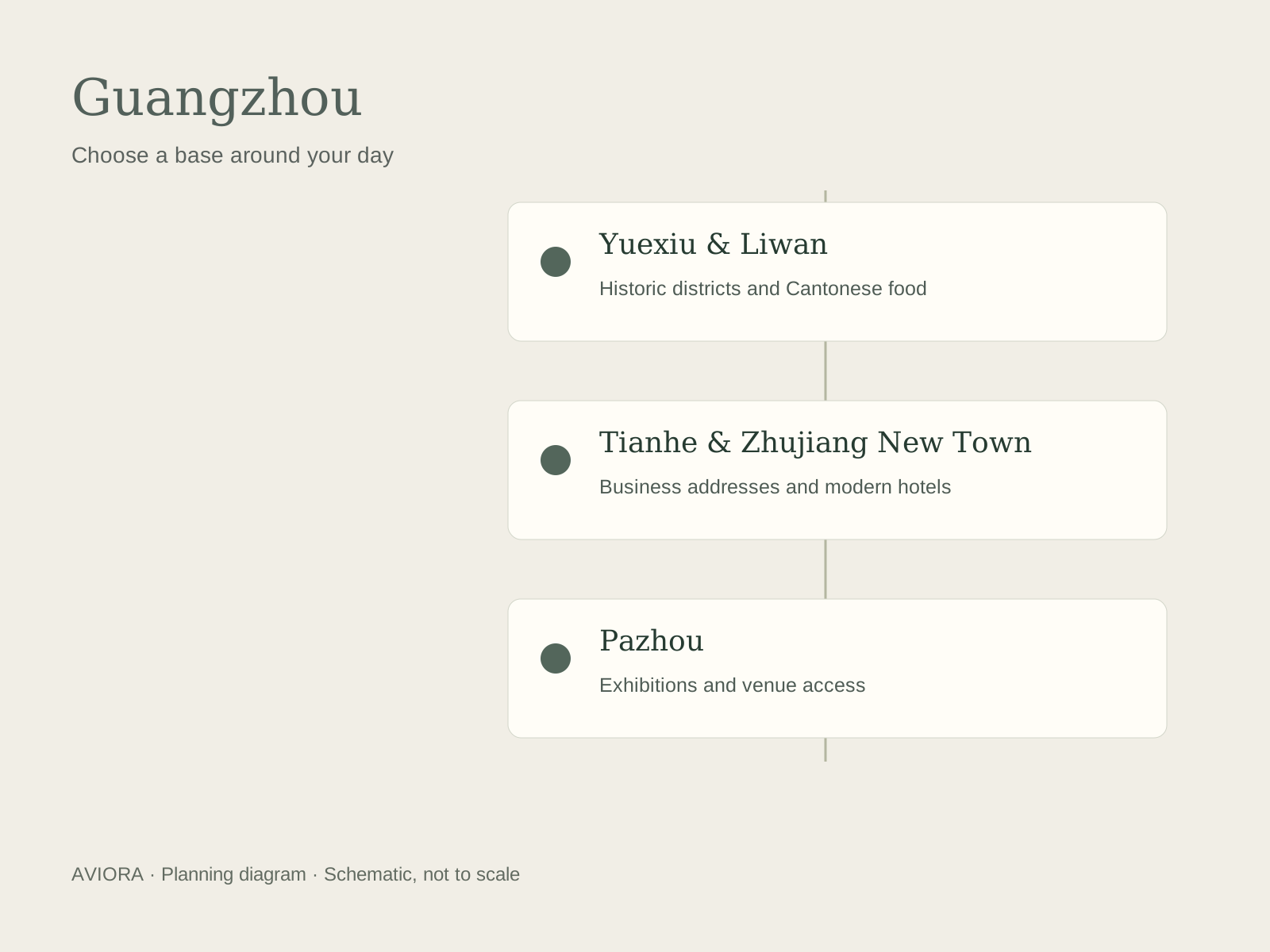
Consider Yuexiu or Liwan for historic neighborhoods and local food, Tianhe and Zhujiang New Town for many business addresses and modern hotels, or Pazhou when exhibition access is the main priority. Verify the actual entrance and daily destination: a hotel advertised as convenient for the Canton Fair may still require a significant journey to your hall or meeting.
Useful for a historic-city and food focus. Compare the exact property and vehicle entrance, nearby meals and room comfort. Older surroundings do not mean every hotel is a heritage property or every walk is step-free.
Consider for business addresses, modern accommodation and dining. Check the side of the district and daily pickup route; the skyline alone is not a practical location test.
Prioritize when repeated exhibition visits justify the base. Check the precise venue and hall, event access arrangements and evening dining rather than assuming all exhibition hotels serve every agenda equally well.
Stay near the relevant Pazhou venue when repeated exhibition days dominate your trip. Choose a central base when sightseeing, food and meetings elsewhere matter more. Compare the complete morning and evening journeys, not just a hotel’s distance to a metro stop. During major events, establish room availability and transport arrangements before adding leisure activities.
Leave time for a proper dim sum or Cantonese meal rather than treating it as a quick tasting between distant sights. Explain allergies, seafood restrictions and food preferences before choosing the venue; steaming and light seasoning do not make a dish suitable for every diet.
A bilingual coordinator, city guide, conference interpreter and technical interpreter perform different jobs. Share the subject, documents, languages and confidentiality needs so the right support can be quoted. Supplier evaluation and quality assurance require their own scope.
Check registration, credentials and badge rules through the event organizer. Travel planning can support your arrival and schedule, but cannot promise admission or substitute for the documents the organizer requires.
A market walk, restaurant meal, private kitchen session and family-hosted encounter are different experiences. Agree the venue, host, language, menu and consent in advance. A traditional medicine introduction is cultural learning, not a medical diagnosis or promised treatment result.
Culture and historical context
The Chen Clan Ancestral Hall introduces Guangdong craftsmanship through carved wood, brick and architectural decoration. Shamian offers a different chapter through its former concession-era streetscape. These are separate stops: combine them with a Liwan food outing only when opening arrangements, heat and walking comfort support the day. Give each place time rather than rushing between distant monuments.
For business visitors, a cultural chapter can add context without competing with the main agenda. A conversation around a market or meal should be properly hosted and interpreted, with permission for photographs and private spaces. It is a chance to learn about contemporary life, not a promise that one family or encounter represents all Cantonese culture.
Food and social life
Dim sum works best as a meal with time to choose and share, rather than a single must-try dish. Rice rolls, dumplings and steamed dishes can introduce the range, while roast meats, soups and seafood offer other directions. Ask about ingredients: pork, shellfish and meat stock may be present in dishes whose names do not make them obvious.
For a premium meal, the right choice depends on your group and the day. A private room, dietary checks, convenient location and a relaxed service pace can matter more than a famous address. Reserve and explain needs in advance; a busy fair day is a poor time to improvise an elaborate dinner far from the hotel.
Guangzhou travel FAQ
Yes. Canton is the historic English name for Guangzhou. Use Guangzhou for current flight, train and hotel searches; the Canton Fair retains its established English name. Cantonese also describes the language and food traditions associated with Guangdong and neighboring communities.
For leisure, two full days usually make a useful introduction, commonly with three nights. Business travel should follow the actual meeting and exhibition agenda. Add separate time for culture rather than assuming it fits after a full working day.
Start with your venue, hall and event dates. A Pazhou base can help with repeated exhibition days; Tianhe or another central area may suit a mixed agenda better. Check actual transport and registration arrangements before choosing.
Yes. Our flexible business journey covers both, with a four-day hotel example of two Guangzhou nights and one Shenzhen night. Your final city sequence and duration follow the confirmed agenda and arrival points.
Not automatically. City guiding and professional interpretation are different services. Share the meeting subject, languages and documents so the required support and service hours can be agreed in writing.
We can discuss a suitable market-to-kitchen or hosted meal within the private plan. The host, venue, menu, timing and dietary arrangements need confirmation. Such a visit is not an automatic addition to every city or business day.
Only the transfers listed in your proposal are included. Exact terminals, venue access, vehicle hours and any cross-boundary permissions affect the plan. Do not assume a mainland airport transfer covers Hong Kong service.
Route combinations
Plan your journey
Share your dates, interests, arrival and departure cities, and any plans already booked. We’ll recommend an itinerary at a pace that suits you, with the arrangements and price explained before you book.
You are asking about Guangzhou.
The enquiry form will load here.
Prefer a direct reply? Message us on WhatsApp or email our China team.