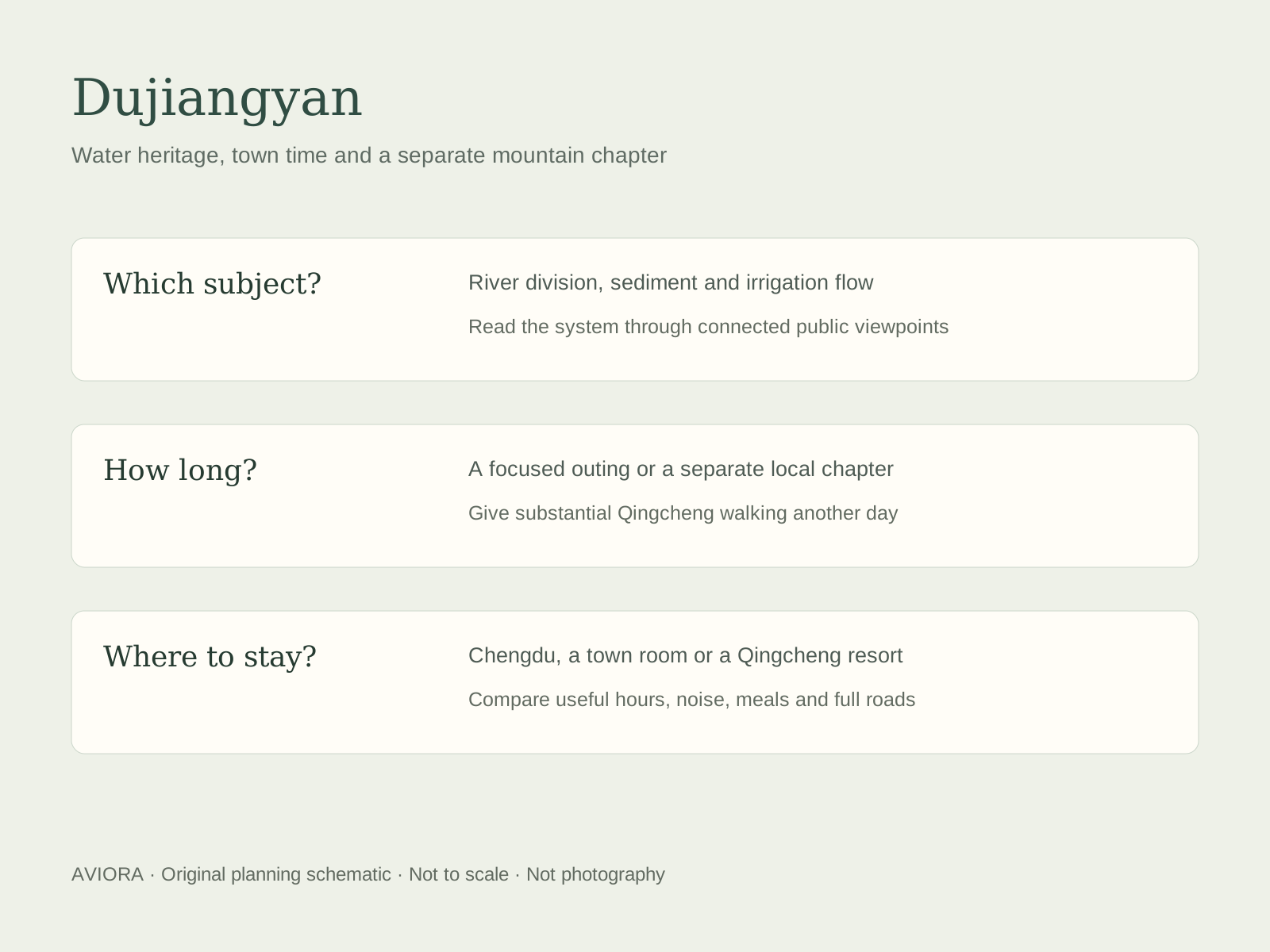
Dujiangyan (都江堰) is both a city administered by Chengdu in Sichuan and the name of its celebrated irrigation system on the Min River. The system, dating to the third century BCE, is best appreciated as a relationship between river division, sediment management and controlled flow, not just a scenic bridge. It shares a UNESCO World Heritage inscription with Mount Qingcheng, but the two require different routes. A focused heritage outing can work from Chengdu or a Qingcheng-area property. Two or three local nights can separate water heritage, a mountain day and hotel time. A panda facility in the Dujiangyan area is another destination, not the irrigation site.
How many days do you need in Dujiangyan?
Choose a return outing when the irrigation system is the main interest and the complete road leaves useful visiting time. One local night can add a town evening and reduce a pressured return. Two nights give one full day; three give two, allowing the heritage route and a selected Qingcheng visit on separate days. A resort-led stay can be longer for a different reason: our ten-day retreat protects seven consecutive Qingcheng-area nights. Count nights, useful local days and the actual purpose separately rather than assume every nearby attraction fits into a single day.
Compare stays by number of nights
Return outing / one clear heritage priority
Keep the Chengdu or Qingcheng room and protect enough time for the chosen public route, explanation, food and complete transport. A brief photo stop is not the same as understanding how the system works. Add another interest only when the actual schedule and physical demands remain comfortable.
1 night / useful town time
Can add a relaxed meal and old-town evening when the exact hotel and onward route work. Check noise, pickup and bags before booking for a night view. An illuminated scene depends on current operation, weather and crowds; do not treat it as guaranteed quiet heritage time.
2–3 nights / separate river and mountain purposes
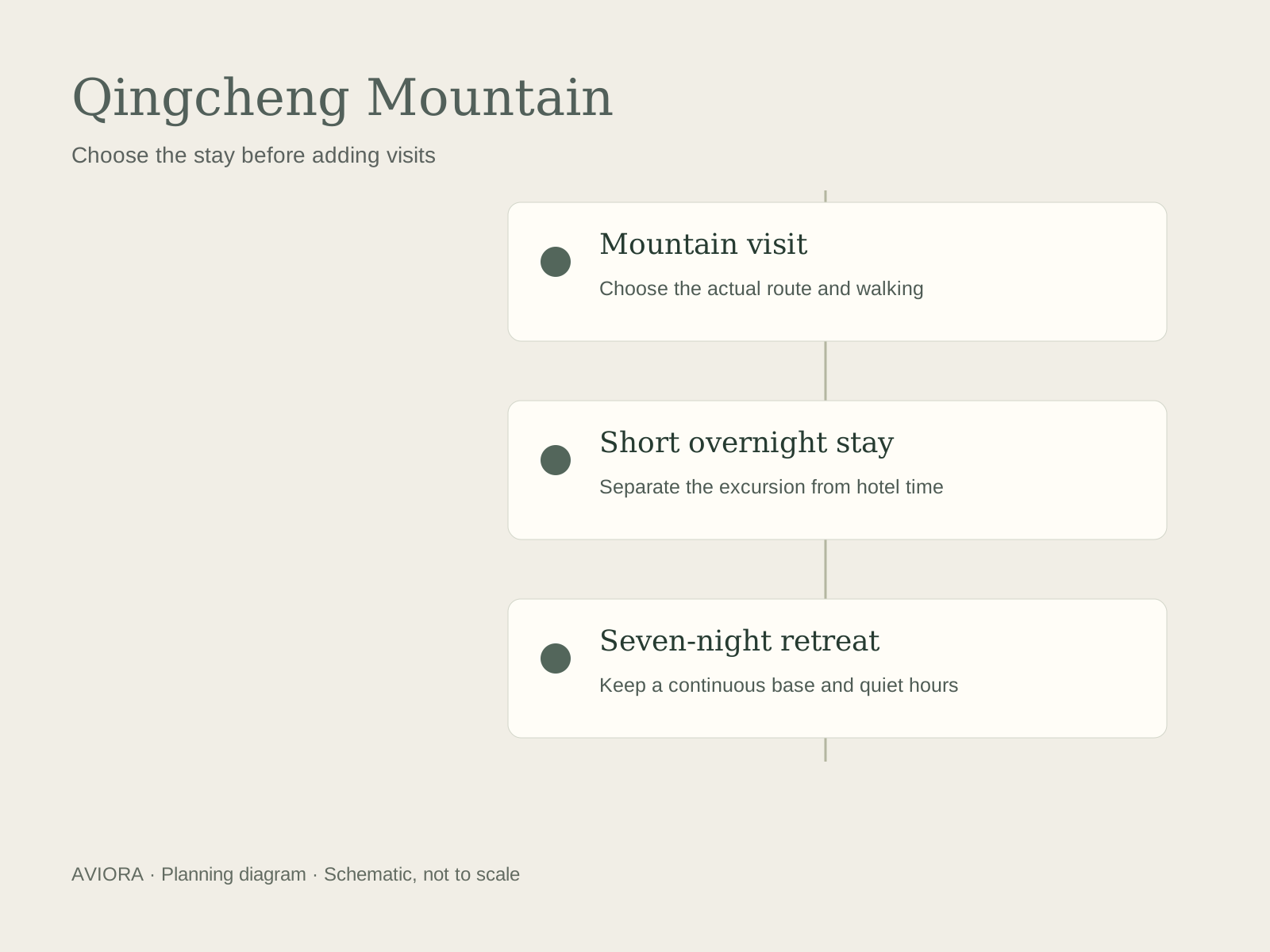
Two nights give one full day; three give two, a better starting point for distinct Dujiangyan and Qingcheng visits with hotel time. Choose the actual town or resort base by those priorities. Seven resort nights in the published retreat are a separate slower commitment, not a requirement to see the water system.
Plan a tailored Dujiangyan visit
Chengdu offers the main city base and separate food, tea and panda interests. Qingcheng adds Daoist heritage, forest walking and a different hotel-led stay. Our ten-day private Qingcheng retreat includes a focused Dujiangyan half day within seven mountain-area nights after two Chengdu nights, alongside a separately tailored mountain day and confirmed sessions. Choose it for the continuous retreat, not as a short Dujiangyan tour. A panda visit elsewhere in the city area is not evidence that another published product includes the irrigation system.
A proposal should name the public heritage route, entrance and exit, tickets, guide language, pickup and return, vehicle hours, meals and any local hotel. Ask how much walking, bridge crossing, standing and climbing remain. A shorter route must still explain the system meaningfully rather than substitute a quick photograph. Private guiding does not authorize operational infrastructure, closed paths, river entry, drones or priority access. A mountain visit, panda facility or cultural host requires its own arrangements, with alternatives for weather and guest needs.
This is a destination planning guide, not a fixed departure or a confirmed package. We check the route, accommodation, transport and guide availability for your dates before setting out the services and price in writing.
Choose the current public route and available entrances before setting pickup. Include admission, the approach, explanation stops, crossings, food and the full return. A half-day heritage chapter from a nearby resort is different from a half-day hotel-to-hotel outing from central Chengdu. Avoid tying the essential river visit to an uncertain arrival flight. Current weather and water-related notices may change public operation, so protect a useful alternative rather than promise a fixed sequence of bridges.
01
Understand river division, sediment and irrigation flow through connected public viewpoints
02
Choose a manageable heritage route with clear explanation and comfortable breaks
03
Enjoy a town evening or a separate mountain day when it improves the wider holiday
Suggested Dujiangyan itinerary
What can you fit into your Dujiangyan itinerary?
Focused outing / arrival
Start with the whole system
Reach the agreed public entrance with admission and full road allowed for. Begin with a concise explanation of river division, sediment and irrigation before following the selected viewpoints. Keep the route realistic for steps, bridges and weather.
Heritage time and meal
Use fewer stops well
Connect visible structures with their roles, allow questions and breaks, then take a suitable meal. Add Erwang Temple or another higher section only when the interest and physical plan justify it. A lower route should still offer coherent interpretation.
Return or local overnight
Protect the next chapter
Return to Chengdu or the Qingcheng resort, or settle into a confirmed town room for a relaxed evening. A substantial mountain visit belongs on another useful day unless a selective combination was explicitly agreed. This outline is illustrative, not a separate published short tour or a guarantee of routes, water conditions or restricted access.
Spring and autumn are useful starting points for comfortable walking, while actual weather, river-related notices and holiday demand determine the dated plan. Summer can be hot and wet; shade, drinking water, slippery surfaces and changing operation need attention. Winter may suit a focused heritage visit with appropriate layers. Visible flow varies, so do not promise the same water scene as a promotional photograph. Check the current public route rather than use season alone as proof of an open bridge or suitable crossing.
What affects the cost of a Dujiangyan trip?
Compare admission, any approved internal transport, guide, vehicle hours, meals and the actual room if staying. Rail fares alone omit station transfers and entrance logistics. A short heritage outing differs from a full-day mountain combination or a seven-night resort stay. A premium should improve interpretation, comfort and coordination rather than imply empty bridges, closed-area access or exclusive use of a public heritage landscape.
Getting there and getting around
How to get to Dujiangyan and plan your stay
Arriving and connecting
Compare the full road from a Chengdu hotel with actual dated rail services and both station transfers. Use the correct station for the chosen heritage, town or mountain property rather than assume the closest-sounding name is best. Airports add another journey from the wider Chengdu region, so protect the essential visit from uncertain arrival. For a local stay, confirm luggage storage, the actual vehicle approach and onward pickup. A private vehicle cannot remove queues, internal walking or current public route restrictions.
Getting around
Set the public route and pickup around the guests' walking tolerance and interest. A through-route and an out-and-back may create different steps, bridge crossings and exit arrangements. Confirm current conditions and suitable internal transport where available; do not rely on a dated account of a shortcut. Town walking, mountain walking and the heritage route each need their own assessment. Keep clear of working infrastructure and follow current notices around water, barriers and closed paths.
Walking and access
Check the chosen route's steps, slopes, bridge surfaces, exposure, seats, toilets and return pickup. Erwang Temple and higher viewpoints can add climbing beyond a lower route. Suspension-bridge movement or narrow busy sections may be uncomfortable for some guests. Rain can make surfaces slippery. A vehicle cannot follow the internal route, and a lower-effort plan is not automatically step-free; assess the actual guest and current accessible arrangements.
What first-time visitors often underestimate
Ask the guide to begin with a simple explanation of where the river goes and why, then connect it to the visible structures. You do not need an engineering background. The useful question at each stop is what role it plays in the whole system. Once that is clear, a smaller number of well-chosen viewpoints can be more memorable than an ambitious walk spent trying to understand a map.
Where to stay in Dujiangyan
Keep a Chengdu hotel for a focused excursion within a wider city holiday. Compare a specific Dujiangyan town property for urban dining and an old-town evening, or a Qingcheng-area resort when hotel time and mountain access are central. Guanxian Ancient City and Nanqiao are useful location references, but exact street, noise, luggage and pickup matter more than a broad old-town label. A river-view room may face evening activity. Confirm bathroom, temperature control, stairs or lift, breakfast and the actual roads to each entrance before choosing a local stay.
Compare hotel areas
Chengdu / keep the wider city base
Practical for one focused heritage excursion and a stronger choice of city meals and accommodation. Compare the full road from the actual hotel and the return after walking. Avoid choosing transport only by a short rail segment or a map distance to the city boundary.
Guanxian Ancient City and wider Dujiangyan town / an evening chapter
Check the exact room's street noise, evening activity, stairs, luggage approach and vehicle stop. An old-town or Nanqiao label does not guarantee historic fabric in the room, a river view or walking access to the preferred heritage entrance. Town and resort stays solve different needs.
Qingcheng-area resort / hotel time and a mountain day
Choose a specific property with useful facilities, meals, quiet and roads to the actual mountain entrance and Dujiangyan. A mountain address does not establish a forest view or a walk to every attraction. Confirm treatment, teaching and other sessions separately from the room.
Can I visit Dujiangyan and Qingcheng Mountain in one day?
A selective combination can be possible with suitable transport, admission and walking, but it is not the same as two unhurried visits. Choose a clear priority and state exactly what is shortened. Qingcheng's front and rear mountain areas are different choices, and cableways do not remove all steps. For guests who want to understand the water system and enjoy a substantial mountain route, separate days are usually more rewarding. Our retreat includes a focused Dujiangyan half day and a different tailored Qingcheng day; it does not compress both into one full mountain-and-river excursion.
Read the three working ideas together
The Fish Mouth helps divide the river, Flying Sand Weir contributes to overflow and sediment management, and Bottle-Neck Channel constrains the irrigation flow. Their relationship matters more than photographing three labels. Ask the guide to explain what can be observed from the available viewpoints and how seasonal conditions alter the visible scene.
Ancient engineering is not an untouched object
The system's long history includes maintenance and adaptation. Distinguish its historic principles from a claim that every visible structure is original to the third century BCE. It remains meaningful as working infrastructure, which is also why visitor access and operational areas differ. A bridge view is a way to learn, not permission to enter a channel.
More viewpoints do not automatically create better understanding
A manageable route with clear explanation can be more rewarding than a strenuous circuit completed in a rush. Compare the extra climbing to Erwang Temple or higher views with the actual interest and fitness. Agree where the route can shorten and how the vehicle return works rather than discover the exit problem after crossing the site.
A town evening and a quiet room are separate choices
Nanqiao and the old-town streets can provide a lively evening contrast, but lights, visitors and music may affect nearby accommodation. Ask about the specific room's outlook and sound insulation. Enjoying the public evening scene does not require sleeping immediately beside it, and a night view is not the same subject as the irrigation system's working logic.
Qingcheng deserves a route, not just a place in the same title
The shared UNESCO inscription does not create a single entrance or an easy complete circuit. Choose the mountain side, walking ambition and current transport separately. If both subjects matter, give them distinct days; if time is short, prioritize one and describe the second honestly as a selective introduction.
A Dujiangyan panda visit is another itinerary
A panda facility, the irrigation landscape and a city hotel occupy different locations. Confirm the named facility, public visiting scope and full road. Do not infer a volunteer program, animal contact, keeper access or an irrigation visit from a tour simply using the word Dujiangyan. The precise itinerary and inclusions decide the match.
Culture and historical context
Working with water is the subject, not just the backdrop
Dujiangyan becomes easier to appreciate when each visible structure has a job in the same explanation. Follow the division of the river, consider where sediment and excess water can move, and look at the controlled channel. The guide's role is to turn a beautiful but complicated scene into a relationship you can follow. That is a different experience from crossing a bridge without knowing why the channels have their particular form.
Its long life also invites a careful historical distinction. An ancient principle can remain important while structures are maintained, altered and repaired over time. Avoid describing everything visible as untouched ancient fabric. The heritage includes continuing management and the landscape's relationship to human settlement and cultivation. Public interpretation offers a way into that story without pretending a visitor can enter the operational system at will.
Food and social life
Let the town meal give the walking day a pause
Choose a comfortable lunch according to the actual exit and next road, rather than force a distant restaurant into a focused heritage outing. Noodles, rice dishes or a shared Sichuan meal can work depending on the kitchen and appetite. An old-town evening is another useful meal opportunity if staying nearby, with lively public streets and a room chosen for sleep. Ask for spice and portion guidance instead of assume every guest wants a demanding banquet after walking.
Review chili, Sichuan pepper, wheat, soy, sesame, peanuts, eggs and stocks in the selected dishes. Mild seasoning is not evidence of allergen control, and vegetables may share stock or cooking surfaces with meat. Confirm the actual kitchen's capacity for strict needs and a practical alternative. Drinking water and a seated break belong in the plan before the walk, especially in heat or when visiting with children and older relatives.
Dujiangyan travel FAQ
Questions about visiting Dujiangyan
Is Dujiangyan a city or an irrigation system?+
Both. Dujiangyan is a city administered by Chengdu, and its name also refers to the historic irrigation system on the Min River. Specify the actual heritage entrance, town hotel or other facility when arranging transport; they are not one location.
Is Dujiangyan worth visiting from Chengdu?+
It can be highly rewarding for an interest in working engineering heritage and river landscapes. Give the route clear interpretation, useful visiting time and the complete return. Guests seeking only a quick bridge photograph may be better served by deciding whether the full outing fits their priorities.
How does the Dujiangyan irrigation system work?+
Its key ideas involve dividing river flow, managing overflow and sediment, and controlling the irrigation channel. Fish Mouth, Flying Sand Weir and Bottle-Neck Channel work together. A good public visit connects those roles while distinguishing historic principles from later maintenance and adaptation.
Can I visit Dujiangyan and Qingcheng Mountain in one day?+
A selective combination may work, but choose a clear priority and acknowledge what is shortened. For a substantial water-heritage route and meaningful mountain walking, separate days usually give better pacing. The shared UNESCO inscription does not create one entrance or eliminate transfers and steps.
Should I stay in Dujiangyan or Chengdu?+
Keep Chengdu for a focused return outing. Choose a specific Dujiangyan town hotel for useful local hours, or a Qingcheng resort for mountain and hotel time. Compare actual room comfort, evening noise, meals and full roads before adding a hotel move.
Does a Dujiangyan panda tour include the irrigation system?+
Not automatically. A named panda facility and the heritage site need different roads, tickets and time. Read the actual itinerary rather than infer inclusion from a city name. Public panda observation also does not establish volunteering, holding or behind-the-scenes access.
Is the Dujiangyan heritage route step-free?+
Do not assume so. Check the current entrance, slopes, bridges, remaining steps, seating, toilets and exit pickup. A shorter or lower route can reduce demands without removing all barriers. Describe mobility and bridge tolerance before choosing the exact plan.
Share your dates, interests, arrival and departure cities, and any plans already booked. We’ll recommend an itinerary at a pace that suits you, with the arrangements and price explained before you book.