Choose Chongzhou for Daoming bamboo weaving, a selective Jiezi old-town visit or settled countryside time, with honest advice on workshops, hotels and Chengdu transfers.
A focused day trip or 2 nights for a rural stayCraft-minded travelers, families and a slower Sichuan interlude
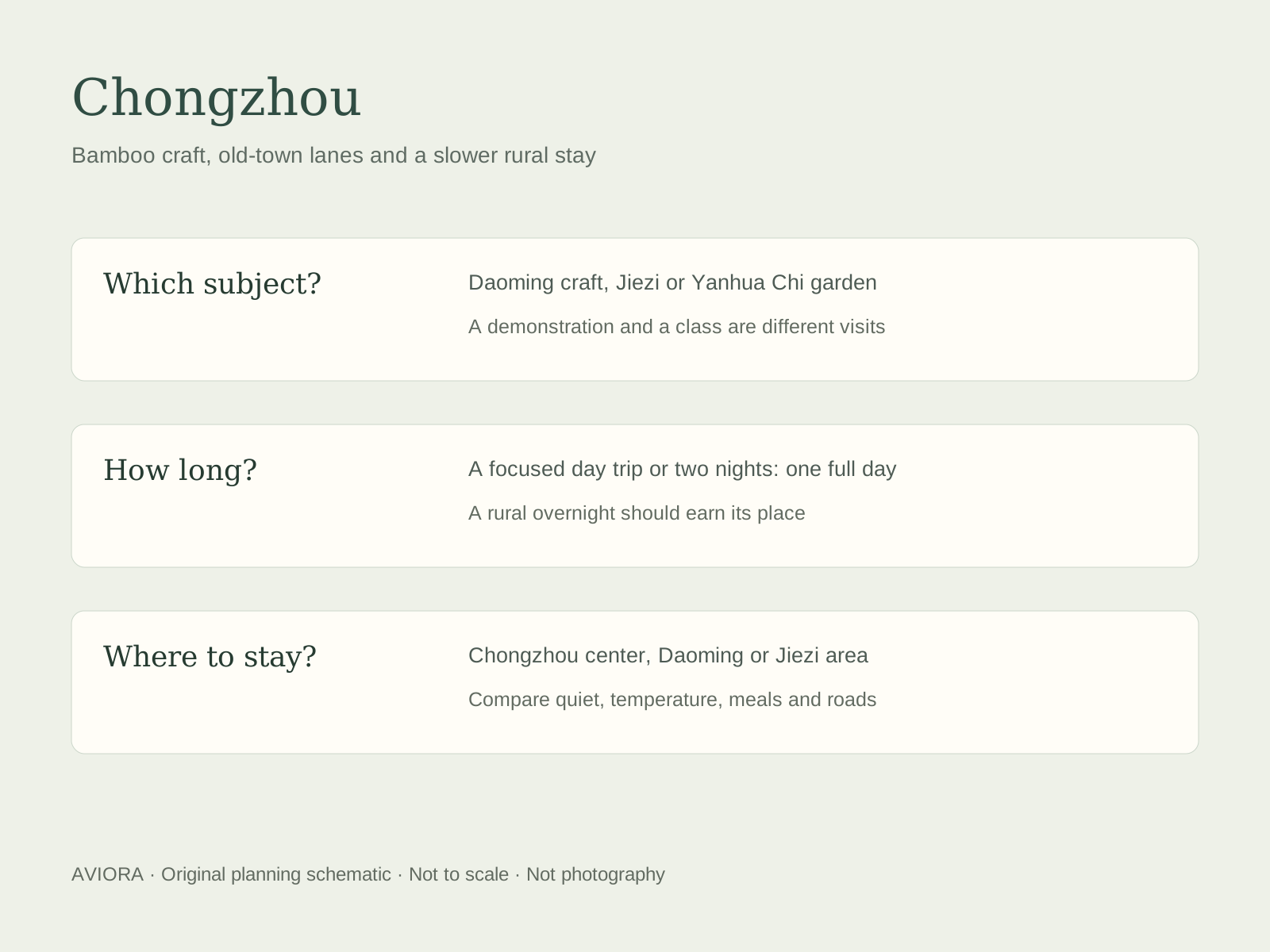
Chongzhou (崇州) is a county-level city administered by Chengdu, west of the central city in Sichuan. It offers several different reasons to leave the urban itinerary: bamboo-weaving traditions around Daoming, the lanes and river setting of Jiezi old town, historic gardens in the Chongzhou center and a rural overnight stay. These places do not form one walkable attraction. For a day trip, choose one main subject and a nearby complement. Stay two nights when a good room, an actual craft session and unhurried countryside time are part of the purpose. A Chengdu visit alone does not cover Chongzhou, and a bamboo-themed building is not evidence that a weaving lesson is available.
How many days do you need in Chongzhou?
A day trip works for one focused Daoming or Jiezi visit with lunch and the complete return to Chengdu. One night can provide an evening and morning but often leaves no full day between check-in and departure. Two nights give one complete day for a confirmed workshop and selected local exploring without moving bags. Three nights need a stronger reason, such as substantial hotel time or separately researched craft interests. Do not add nights merely to collect nearby place names; decide what guests will actually do between meals and sleep.
Compare stays by number of nights
Day trip / one main interest
Choose a confirmed Daoming craft visit or a Jiezi-led day, with lunch and one sensible complement. Keep the complete pickup and return to the actual Chengdu hotel explicit. A productive craft session is worth more than rushing through three unrelated photo stops.
1 night / only when arrival and departure help
Use a quieter evening or morning and a room you want to enjoy. Review the actual hours on both days; one night does not automatically create a full local day. Keep workshop timing separate from an uncertain check-in or a fixed onward train.
2 nights / one complete countryside day
Settle into one base, give a workshop time and retain a gentle walk or garden interest. Compare travel to the selected subjects before booking the room. Extra space in the schedule should make the visit more personal, not create pressure to include every town and mountain nearby.
Plan a tailored Chongzhou visit
Chongzhou can follow Chengdu's city, food or panda days when guests want a different pace. Qingcheng Mountain offers a separate Daoist landscape and more physical walking, with its own hotel and route decisions. Leshan is another regional chapter with a substantial journey and its own Buddha-viewing choices; it should not be appended to the same short craft day. No matching published Chongzhou tour is recommended here. Share your dates, Chengdu hotel, craft interests, children's ages and room priorities to discuss a tailored day or stay.
A proposal should identify the craft venue or host, the actual format, teaching language or interpreter, session length, materials, suitable ages and what guests can take home. Name the hotel and room, public sites, transport, guiding and meals separately. A private car is transport, not an English-speaking craft instructor. A family home, working studio, closed religious space or private courtyard requires explicit permission. Agree a useful alternative if a host becomes unavailable, rather than replace a booked class with an unannounced shopping stop.
This is a destination planning guide, not a fixed departure or a confirmed package. We check the route, accommodation, transport and guide availability for your dates before setting out the services and price in writing.
Anchor the day around the confirmed host or principal site. A workshop needs arrival, introduction, demonstration, practice, questions and packing, not just the nominal teaching time. Add one nearby walk or meal rather than stack distant stops. Weekend leisure traffic and events can change the feel of Jiezi and rural properties. For a stay, protect both useful local hours and time to enjoy the room instead of arriving late and leaving immediately after breakfast.
01
Understand bamboo weaving through a defined Daoming visit rather than a generic craft-shopping stop
02
Choose a Jiezi walk or Yanhua Chi garden for a contrasting local subject
03
Enjoy a countryside meal and a comfortable room with genuine time to settle in
Suggested Chongzhou itinerary
What can you fit into your Chongzhou itinerary?
Day-trip option / departure from Chengdu
Give one craft or old-town subject time
Reach a confirmed Daoming host for the agreed format, or choose a Jiezi-led visit. Allow a proper lunch and one nearby complement if useful. Return to the actual Chengdu hotel with the complete road planned; this is a selective day, not every Chongzhou interest.
Two-night option / arrival
Settle into a room worth staying for
Travel to the named property, check the facilities and enjoy a modest local walk or garden visit if hours suit. Keep an essential host appointment away from an uncertain arrival. Eat locally and let the evening be part of the reason to stay.
Full local day
Learn, eat and explore at a comfortable pace
Give the actual workshop its time, including introduction, practice and questions. Follow with lunch and a selected local route. Choose the order around the host and weather. Do not automatically add a distant mountain, a second town and another craft sales stop.
Departure / onward route
Leave with the connection protected
Allow breakfast, bags and the complete road to the next hotel or ticketed gateway. This outline is illustrative, not a published package or a guarantee of hosts, rooms, classes, private access, flowering or current activities.
Spring and autumn are useful starting points for village walks and outdoor meals, with rain and temperature still relevant. Summer can be hot, humid and wet, making shade, cooling and a proper indoor break important. Winter can feel damp and chilly; check actual room heating rather than rely on an attractive fireplace image. Flowering, field color and harvest vary by location and year. Weekends and holidays can feel busier, so choose dates around the actual host, room and purpose rather than a generic claim of empty countryside.
What affects the cost of a Chongzhou trip?
Compare the complete Chengdu return or onward road, guide preparation, interpreter, actual host fee, teaching materials, meals, admissions where applicable and the exact room. A demonstration, practical class and extended specialist visit have different costs and purposes. Purchases are optional and separate unless clearly agreed. A premium should buy useful teaching, a comfortable base and thoughtful timing; it does not imply an exclusive master encounter or private use of an entire village.
Getting there and getting around
How to get to Chongzhou and plan your stay
Arriving and connecting
Start with the actual Chengdu hotel, ticketed station or airport and the precise Chongzhou destination. Chengdu Tianfu and Shuangliu airports are distinct road journeys. A rail option needs a dated service and a final transfer to the correct village or room. If continuing after a workshop, protect the whole onward connection and leave time to pack the work. Keep a named host appointment away from an uncertain flight arrival.
Getting around
Plan the road sequence between the exact workshop, lunch, walk and hotel. A car can simplify the outing but cannot drive into every lane, courtyard or public garden. Agree walking, pickup, toilets and a comfortable seated break. For specialist craft interests, arrange interpretation rather than expect the driver to explain materials and technique. Avoid repeatedly crossing between the center, Daoming and Jiezi merely to fill an itinerary.
Walking and access
Village lanes, old-town paving, thresholds, garden paths and workshop seating need individual review. Bamboo work can involve fine hand movements, sharp tools or sustained sitting; choose an adapted task for children or limited dexterity. Shaded village time is not the same as a mountain hike. Confirm vehicle approach, bag distance, toilets and places to rest. A rural property should be assessed room by room rather than described generally as accessible because the surroundings look flat.
What first-time visitors often underestimate
Tell the planner whether you want to watch an artisan work, learn a simple technique or choose a finished piece. Those lead to different hosts and schedules. Then decide whether Jiezi, a garden or the room deserves the remaining time. Chongzhou works best as a deliberate change of pace from Chengdu, not a checklist of everything that can be pinned west of the city.
Where to stay in Chongzhou
Compare a central Chongzhou hotel for gardens, food and practical services, a specific Daoming-area rural property for the craft route, and a Jiezi-area room for useful old-town hours. None is automatically the best base for all three. Rural architecture and a photogenic courtyard do not establish quiet sleep, effective cooling, heating or a comfortable bathroom. Ask about the exact room, road approach, luggage, dinner, breakfast and weekend events. Stay in Chengdu when the countryside visit is brief and moving hotels would add more inconvenience than value.
Compare hotel areas
Chongzhou center / gardens, meals and services
Useful for a Yanhua Chi and town-focused stay or guests who prefer established urban services. Compare the room, quiet and actual pickup. Daoming and Jiezi still require separate road planning; a central Chongzhou address is not a village doorstep.
Daoming countryside / craft-led rural time
Choose a specific property for its relationship to the actual host and its room comfort. Ask about dinner, breakfast, insect screens where relevant, heating or cooling, bathroom privacy and luggage approach. A bamboo design theme does not establish a working craft program at the hotel.
Jiezi area / useful old-town hours
Compare an exact room for lane or roadside noise, crowds, vehicle access and after-dark dining. An old-town label can refer to very different locations and building conditions. A courtyard can be attractive while still requiring a serious sound, temperature and bathroom check.
Keep the Chengdu room / when moving adds little
A day trip can be the better choice if the visit is short or the rural room adds little comfort. Retain the central hotel, make one focused outing and return for the evening. An overnight should earn its place through the experience rather than be treated as automatically more authentic.
Should I choose Daoming, Jiezi or Chongzhou's historic garden?
Choose Daoming for a real interest in bamboo craft, with a particular workshop or host arranged. Choose Jiezi for a selective old-town walk, riverside time and a meal, accepting that it is also a busy contemporary visitor destination. Choose Yanhua Chi in the Chongzhou center for a historic garden interest and a different reading of the city. A short visit should have one lead subject. Combining all three without time for explanation, food and transfers usually weakens the day, especially when a practical craft session is the priority.
Watching, learning and buying are different visits
A demonstration can explain technique without hands-on teaching. A class needs a task suited to the available time and guest ability. Shopping needs provenance, price and shipping questions. Agree which you want so a short sales presentation is not substituted for learning, and guests never feel required to purchase to justify a visit.
Ask what you will learn from bamboo weaving
Look at how bamboo is prepared into strips, how an edge is finished and how tension affects the shape. In a short introduction, prepared materials and a simple pattern may be more appropriate than trying every production stage. The task, teacher and explanation matter more than an ambitious promise to make a complex object from scratch.
Jiezi is a living visitor destination, not a preserved empty set
Historic associations, repaired buildings, modern shops and everyday tourism coexist. Walk a selected route and discuss what you see instead of assigning one ancient construction date to the entire streetscape. An early or later visit may feel different, but quiet lanes and empty photographs are not guaranteed.
Countryside views are seasonal and agricultural
Fields are working landscapes, not permanent flower displays. Planting, harvest, weather and land access change what is visible. Choose a public route and respect crops, water channels and household space. A host's permission for a studio does not extend to every nearby house or field.
A garden adds a different kind of attention
At Yanhua Chi, allow time for the relationship between water, paths, planting and buildings rather than a rapid lap. Explain the garden's historical layers without treating every present structure as original. The central-city location makes it a distinct choice from a village craft visit or an old-town riverside walk.
High-end means a better day, not an unnamed exclusive host
A prepared interpreter, appropriate task, comfortable seat, good lunch and enough time to ask questions can make a craft visit exceptional. Confirm any named specialist or private session separately. A fashionable hotel or the word 'artisan' cannot establish the quality of the teaching or special access.
Culture and historical context
Read the craft through material and technique
Daoming's bamboo-weaving interest is strongest when the material becomes understandable. Look at the width and flexibility of a strip, how a pattern repeats, how the maker changes tension and how a rim is finished. These small decisions explain skill more clearly than a claim that every object is an ancient masterpiece. A short class can focus on one prepared task while a demonstration shows more demanding stages safely.
Tradition also includes adaptation, contemporary design and ordinary household use. Distinguish the maker's own work, items brought in for sale and a visitor exercise. Ask before photographing people or entering a working room, and let the host explain which stages are practical that day. Thoughtful interpretation gives the visit depth without requiring an exclusive encounter or turning someone's working life into a staged performance.
Food and social life
Let a regional lunch support the countryside day
A Sichuan meal can provide a relaxed pause after close handwork or a lane walk. Ask for a balanced selection of vegetables, a suitable main dish and the amount of chili and numbing pepper you enjoy. Farm-style dining is a format to assess, not a guarantee that every ingredient was grown beside the table. A good host can explain the cooking and ingredients without turning lunch into a compulsory oversized tasting menu.
Check stocks, pork, wheat, soy, sesame and shared preparation where relevant. A vegetable dish or a mild request does not establish vegetarian, allergy, coeliac or halal suitability. Serious needs require a particular kitchen's confirmed capacity and an alternative. At a rural property, review breakfast and dinner as carefully as the bedroom; a pleasant courtyard does not help if the only suitable meal requires an unexpected late road trip.
Chongzhou travel FAQ
Questions about visiting Chongzhou
Is Chongzhou worth visiting from Chengdu?+
Yes, when bamboo craft, an old-town walk, a historic garden or a rural stay is a real interest. Choose one main subject for a day trip. If the plan is only a few photographs without a meaningful visit or useful room, moving out of Chengdu may add little.
Can I take a bamboo-weaving class in Daoming?+
Treat it as a service to confirm with a specific host. Agree the task, language, duration, materials, age suitability and take-home work. A village visit, demonstration or bamboo-themed building does not automatically include a practical lesson.
Should I visit Daoming or Jiezi old town?+
Choose Daoming for an arranged bamboo-craft interest and Jiezi for old-town lanes, river time and a meal. They are separate road stops. A short day should prioritize the stronger interest instead of promise equal depth at both.
How many nights should I stay in Chongzhou?+
A focused day trip is often enough for one subject. Two nights give one full countryside day and useful hotel time. One night depends on the real arrival and departure hours; three need a stronger craft, leisure or accommodation purpose.
Is Chongzhou suitable for families?+
It can be when the craft task, tools, sitting time, meals and room suit the children's ages. Confirm a simple activity rather than assume an adult workshop adapts automatically. Include toilets, rest and safe public walking, and respect working fields and household boundaries.
Can I combine Chongzhou with Qingcheng Mountain?+
Consider it as a separate route and physical day with the exact hotel transfers assessed. A substantive craft session and a full mountain visit both need time. An existing Qingcheng retreat does not automatically include Chongzhou or establish its workshop services.
Does a private Chongzhou visit require buying craft products?+
Purchases should be optional unless a specific material or object is explicitly part of the agreed service. Teaching, hosting and shopping are different costs. Ask about provenance, shipping and materials when buying rather than assume every item in a craft village was made by the person you meet.
Share your dates, interests, arrival and departure cities, and any plans already booked. We’ll recommend an itinerary at a pace that suits you, with the arrangements and price explained before you book.